Advertisements
Advertisements
Question
Co-ordinate of point P on a number line is - 7. Find the co-ordinates of points on the number line which are at a distance of 8 units from point P.
Advertisements
Solution
Let point Q be at a distance of 8 units from P and on left side of P
Let point R be at a distance of 8 units from P and on right side of P.
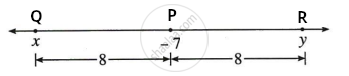
(i) Let the co-ordinate of point Q be x.
Co-ordinate of point P is -7.
Since, point Q is to the left of point P.
∴ -7 > x
∴ d(P, Q) = -7 - x
∴ 8 = -7 - x
∴ x = -7 - 8
∴ x = -15
(ii) Let the co-ordinate of point R be y.
Co-ordinate of point P is -7.
Since, point R is to the right of point P.
∴ y > -7
∴ d(P, R) = 7 - (-7)
∴ 8 = y + 7
∴ 8 - 7 = 7
∴ y = 1
∴ The co-ordinates of the points at a distance of 8 units from P are -15 and 1.
APPEARS IN
RELATED QUESTIONS
If the co-ordinate of A is x and that of B is y, find d(A, B).
x = - 3, y = 7
If the co-ordinate of A is x and that of B is y, find d(A, B).
x = -4, y = -5
Sketch proper figure and write the answer of the following question.
If X-Y-Z and l(XZ) = `3sqrt7`, l(XY) = `sqrt7`, then l(YZ) = ?
Co-ordinates of the pair of points are given below. Hence find the distance between the pair.
x + 3, x - 3
Co-ordinates of the pair of points are given below. Hence find the distance between the pair.
- 25, - 47
If A-B-C and d(A, C) = 17, d(B, C) = 6.5 then d(A, B) = ?
Co-ordinate of point A on a number line is 1. What are the co-ordinates of points on the number line which are at a distance of 7 units from A?
Find the distance between the following pair of points
(1, 2) and (4, 3)
Find the distance between the following pair of points
(3, 4) and (−7, 2)
Find the distance between the following pair of points
(a, b) and (c, b)
Find the distance between the following pair of points
(3, −9) and (−2, 3)
Show that the following points taken in order to form an isosceles triangle
A(5, 4), B(2, 0), C(−2, 3)
Verify that the following points taken in order to form the vertices of a rhombus
A(1, 1), B(2, 1), C(2, 2) and D(1, 2)
The radius of a circle with centre at origin is 30 units. Write the coordinates of the points where the circle intersects the axes. Find the distance between any two such points.
The point whose ordinate is 4 and which lies on the y-axis is _______________
The distance between the point (5, −1) and the origin is _________
Find the distance with the help of the number line given below.

d(J, A)
Find the distance with the help of the number line given below.

d(J, H)
Find the distance with the help of the number line given below.

d(K, O)
