Advertisements
Advertisements
Question
Verify that the following points taken in order to form the vertices of a rhombus
A(1, 1), B(2, 1), C(2, 2) and D(1, 2)
Advertisements
Solution
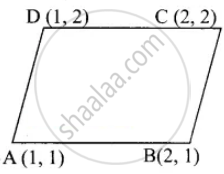
Distance = `sqrt((x_2 - x_1)^2 + (y_2 - y_1)^2`
AB = `sqrt((2 - 1)^2 + (1 - 1)^2`
= `sqrt((1)^2 + (0)^2`
= `sqrt(1)`
= 1
BC = `sqrt((2 - 2)^2 + (2 - 1)^2`
= `sqrt((0)^2 + (1)^2`
= `sqrt(1)`
= 1
CD = `sqrt((1 - 2)^2 + (2 - 2)^2`
= `sqrt((- 1)^2 + (0)^2`
= `sqrt(1)`
= 1
AD = `sqrt((1 - 1)^2 + (2 - 1)^2`
= `sqrt((0)^2 + (1)^2`
= `sqrt(1)`
= 1
AB = BC = CD = AD = 1.
All the four sides are equal.
∴ ABCD is a rhombus.
APPEARS IN
RELATED QUESTIONS
Sketch proper figure and write the answer of the following question.
If R-S-T and l(ST) = 3.7, l(RS) = 2.5, then l(RT) = ?
Find d(A, B), if co-ordinates of A and B are -2 and 5 respectively.
If P - Q - R and d(P, Q) = 2, d(P, R) = 10, then find d(Q, R).
Co-ordinates of the pair of a point is given below. Hence find the distance between the pair.
3, 6
Co-ordinates of the pair of points are given below. Hence find the distance between the pair.
0, - 2
Co-ordinates of the pair of points are given below. Hence find the distance between the pair.
80, - 85
If A-B-C and d(A, C) = 17, d(B, C) = 6.5 then d(A, B) = ?
Determine whether the given set of points are collinear or not
(7, −2), (5, 1), (3, 4)
Show that the following points taken in order to form an equilateral triangle
`"A"(2, 2), "B"(-2, -2), "C"(-2sqrt(3), 2sqrt(3))`
A(−1, 1), B(1, 3) and C(3, a) are point and if AB = BC, then find ‘a’
