Advertisements
Advertisements
Question
The point (x, y) is equidistant from the points (3, 4) and (−5, 6). Find a relation between x and y
Advertisements
Solution
Let the point O be (x, y), A be (3, 4) and B be (−5, 6).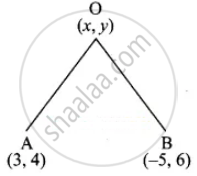
Distance = `sqrt((x_2 - x_1)^2 + (y_2 - y_1)^2`
Given, OA = OB
`sqrt((x - 3)^2 + (y - 4)^2) = sqrt((x + 5)^2 + (y - 6)^2`
Squaring on both sides
(x – 3)2 + (y – 4)2 = (x + 5)2 + (y – 6)2
x2 – 6x + 9 + y2 – 8y + 16 = x2 + 10x + 25 + y2 – 12y + 36
x2 + y2 – 6x – 8y + 25 = x2 + y2 + 10x – 12y + 61
6x – 10x – 8y + 12y = 61 – 25
⇒ – 16x + 4y = 36 ........(÷ 4)
⇒ – 4x + y = 9
∴ The relation between x and y is y = 4x + 9
APPEARS IN
RELATED QUESTIONS
If the co-ordinate of A is x and that of B is y, find d(A, B).
x = 1, y = 7
Sketch proper figure and write the answer of the following question.
If X-Y-Z and l(XZ) = `3sqrt7`, l(XY) = `sqrt7`, then l(YZ) = ?
Find d(A, B), if co-ordinates of A and B are -2 and 5 respectively.
Co-ordinates of the pair of points are given below. Hence find the distance between the pair.
0, - 2
Find the distance between the following pair of points
(1, 2) and (4, 3)
Find the distance between the following pair of points
(3, −9) and (−2, 3)
The distance between the two points (2, 3) and (1, 4) is ______
If the points A(2, 0), B(– 6, 0), C(3, a – 3) lie on the x-axis then the value of a is _____
Find the distance with the help of the number line given below.

d(J, A)
Find the distance with the help of the number line given below.

d(O, E)
