Advertisements
Advertisements
Question
Let A(2, 3) and B(2, −4) be two points. If P lies on the x-axis, such that AP = `3/7` AB, find the coordinates of P.
Advertisements
Solution
Given points are A(2, 3) and B(2, −4)
The point P lies on the x-axis.
∴ The point P is (x, 0)
AP = `3/7"AB"`
`"AP"/"AB" = 3/7`
`"AP"/"PB" = 3/4` ...(1)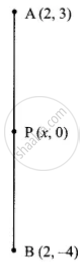
Distance = `sqrt((x_2 - x_1)^2 + (y_2 - y_1)^2`
AP = `sqrt((x - 2)^2 + (0 - 3)^2`
= `sqrt(x^2 - 4x + 4 + 9)`
= `sqrt(x^2 - 4x + 13)`
BP = `sqrt((x - 2)^2 + (0 + 4)^2`
= `sqrt(x^2 - 4x + 4 + 16)`
= `sqrt(x^2 - 4x + 20)`
From (1) we get
`"AP"/"PB" = 3/4`
`(sqrt(x^2 - 4x + 13))/(sqrt(x^2 - 4x + 20)) = 3/4` ...(squaring ob both sides)
`(x^2 - 4x + 13)/(x^2 - 4x + 20) = 9/16`
16x2 – 64x + 208 = 9x2 – 36x + 180
16x2 – 9x2 – 64x + 36x + 208 – 180 = 0
7x2 – 28x + 28 = 0
x2 – 4x + 4 = 0
(x – 2)2 = 0
x – 2 = 0
x = 2
∴ The point P is (2, 0)
APPEARS IN
RELATED QUESTIONS
If the co-ordinate of A is x and that of B is y, find d(A, B).
x = 6, y = - 2
If the co-ordinate of A is x and that of B is y, find d(A, B).
x = 4, y = - 8
Find d(A, B), if co-ordinates of A and B are -2 and 5 respectively.
On a number line, co-ordinates of P, Q, R are 3, -5 and 6 respectively. State with reason whether the following statement is true or false.
d(P, Q) - d(P, R) = d(Q, R)
Co-ordinates of the pair of points are given below. Hence find the distance between the pair.
- 4, 5
Co-ordinates of the pair of points are given below. Hence find the distance between the pair.
- 25, - 47
Show that the following points taken in order to form an equilateral triangle
`"A"(2, 2), "B"(-2, -2), "C"(-2sqrt(3), 2sqrt(3))`
Show that the following points taken in order to form the vertices of a parallelogram
A(−7, −3), B(5, 10), C(15, 8) and D(3, −5)
If (x + 2, 4) = (5, y – 2), then the coordinates (x, y) are _____
Find the distance with the help of the number line given below.

d(P, J)
