Advertisements
Advertisements
Question
Choose two of the passages (a) to (c) and answer briefly the questions that follow:
Raina :
Come away from the window (She takes him firmly back to the middle of the room. The moment she releases him he turns mechanically towards the window again. She seizes him and turns him back, exclaiming) Please! (He becomes motionless, like a hypnotized rabbit, his fatigue gaining fast on him. She releases him, and addresses him patronizingly). Now listen. You must trust to our hospitality. You do not yet know in whose house you are. I am a Petkoff.
The Man: A pet what?
Raina : [rather indignantly] I mean that I belong to the family of the Petkoffs, the richest and best known in our country.
The Man: Oh yes, of course. I beg your pardon. The Petkoffs, to be sure. How stupid of me!
Raina: You know you never heard of them until this moment. How can you stoop to pretend!
The Man: Forgive me. I'm too tired to think, and the change of subject was too much for me. Don't scold me.
(i) Why did the man keep turning to the window?
(ii) Which examples of the social superiority of the Petkoff's does Raina give the man?
(iii) Which opera does Raina mention? With whom does she compare herself? What does this tell you about her?
(iv) In Raina's opinion, what should the man have done instead of threatening her?
(v) What does the man tell Raina about his father? Why does he do so?
(vi) What does the man do at the end of the scene?
Advertisements
Solution
(i)
The man kept turning to the window as there was a young lady, on the balcony intensely conscious of the romantic beauty and also there was a peak of Balkan which was wonderful, white & beautiful.
(ii)
Raina describes the opera is the hospitality of a nobleman is sacred & inviolable and also about the social superiority of Petkoffs & said that they were the richest & best known in the country
(iii)
Raina mentioned that she belongs to the family of the Petkoff's, who were the richest & best known in the country. This shows that she was proud to be a part of this family & had a feeling of being superior.
(iv)
In Raina’s opinion, the man should have trusted their hospitality & discuss things with all of them instead of threatening her or hurt any woman under any circumstances.
(v)
The man tells Raina that his father was a hospitable man himself & he owns six hotels in Switzerland as he wanted to divert her mind & may want to call her mother.
(vi)
The man towards the end of the scene falls asleep after kissing Raina’s hand despite Raina asking him to be awake and didn't wake up even after trying several times.
APPEARS IN
RELATED QUESTIONS
A1. Choose two sentences that appropriately mention the theme of the passage :
(1) The extract deals with the writer’s concern over Chaitanya's handicap.
(2) The extract depicts the writer’s proud feelings towards her son’s achievement.
(3) The extract deals with how Chaitanya made the writer see positively towards life.
(4) The extract deals with how the writer helps Chaitanya to buy the bus ticket.
Early in 1997-98, when he returned from state-level inter-school sports, he had two prizes to his credit and a silver medal. He had won his laurels in athletic events and the silver medal in a running race.
When I saw the prizes and read the citation Chaitanya had received, I was stupefied, in total disbelief, then–hugged him, kissed him and cried unabashedly to my heart’s content. That day, I cried for the first time out of joy and a sense of being vindicated. Without practice, he had competed with approximately 1,800 children drawn from various schools all over the state. He was subsequently selected for the marathon race, but he could not participate due to a health problem. “Maybe next year, he would”, I assured myself. And I, as his proud mother, would proudly chronicle his future achievements and success to inspire other - mothers of the world.
Looking back at my own life, I feel that it is the spirit with which we can accept our life gracefully is what
matters ultimately; and it is love that nourishes us. All other things are unimportant. Chaitanya has made me look inwards. His handicap doesn’t disturb me any longer. He and I shall live with it and still be happy. The mental strength which he has given to me is inexhaustible.
One day, as both of us got onto a public transport bus, Chaitanya offered to buy the tickets for us.
“One full, one half ”, he said to the conductor beaming with joy.
Looking at him, I wondered whether he was really only a half? An incomplete person? Was I really full?
Complete in all respects? Why do then normal people feel that they are ‘full’ and others like Chaitanya are ‘half’ or incomplete? Chaitanya’s world is complete in itself, pure and innocent while our lives are full of deceit, jealousies, ill-feelings.
A2. Point out -
Point out two instances where you find Chaitanya's victory over his disability.
A3. Give reasons -
Chaitanya’s silver medal in a running race was very special for the writer, because :
(i) __________________
(ii) __________________
A4. Vocabulary -
Match the pairs of the words in column ‘A’ with their meanings in column ‘B’:
| Column ‘A’ | Column ‘B’ | ||
| (1) | stupefied | (a) | official statement about the special act of courage |
| (2) | chronicle | (b) | record events in the order they happened |
| (3) | vindicated | (c) | surprised or shocked |
| (4) | citation | (d) | justified |
A5. Personal response -
Explain, your views about the ill-treatment the special children receive in society.
A6. Grammar -
Rewrite the following sentences in the ways instructed :
(i) He had won his laurels in athletic events and the silver medal in a running race.
(Rewrite the sentence using ‘not only...but also’.)
(ii) When I saw the prizes, I was stupefied.
(Rewrite the sentence using ‘No sooner.... than’.)
Explain how diction is important in the poem with the help of an example.
Explain:
Thus I entered, and thus I go!
In triumphs, people have dropped down dead.
Alack, it was I who leaped at the sun
To give it my loving friends to keep!
Naught man could do,have I left undone:
And you see my harvest, what I reap
This very day, now a year is run.
Read the above lines and answer the question that follow.
What does the word ‘harvest ‘ connote here?
Your school recently held a jubilee celebration. Write a letter to your friend who was unable to attend, giving details of the function and your role in it.
Sergius tells Bluntschli in the play "you're not a man, you're a machine." Do you agree with Sergius' assessment of Blunts ii? Give your views.
Why couldn't the narrator sleep?
Read the following passage carefully and answer the questions that follow:
Lying in bed, Swami realized with a shudder that it was Monday morning. It looked as though only a moment ago, it had been the last period on Friday; already, Monday was here. He hoped that an earthquake would reduce the school building to dust but that my good building, Albert Mission School, had withstood similar prayers for over a hundred years now.
At nine o'clock, Swaminathan wailed, “I have a headache.”
His mother said, “Why don’t you go to school in a bullock cart?”
“So that I may be completely dead at the other end? Have you any idea what it means to be jolted in a cart?”
“Have you any important lessons today?”
“Important! Bah! That geography teacher has been teaching the same lesson for over a year now. And we have arithmetic, which means for a whole period we are going to be beaten by the teacher............ Important lessons!”
And Mother generously suggested that Swami might stay at home.
At 9:30, when he ought to have been lining up in the school prayer hall, Swami was lying on the bench in Mother’s room.
Father asked him, “Have you no school today?”
“Headache,” Swami replied,
“Nonsense! Dress up and go.”
“Headache.”
“Loaf about less on Sundays, and you will be without a headache on Monday.”
Swami knew how stubborn his father could be and changed his tactics.
“I can’t go so late to class.”
“I agree, but you’ll have to; it is your own fault. You should have asked me before deciding to stay away.”
“What will the teacher think if I go so late?”
“Tell him you had a headache, and so are late.”
“He will beat me if I say so.”
“Will he? Let us see. What is his name?”
“Mr. Samuel.”
“Does he beat the boys?”
“He is very violent, especially with boys who come late. Some days ago, a boy was made to stay on his knees for a whole period in a corner of the class because he came late, and after getting six cuts from the cane and having his ears twisted, I wouldn’t like to go late to Mr Samuel’s class.”
“If he is so violent, why not tell your headmaster about it?”
“They say that even the headmaster is afraid of him. He is such a violent man.”
And then Swami gave a lurid account of Samuel’s violence; how when he started caning, he would not stop till he saw blood on the boy’s hand, which he made the boy press to his forehead like a Vermillion marking. Swami hoped his father would be made to see that he couldn’t go to his class late. But his father’s behaviour took an unexpected turn. He became excited.
“What do these people mean by beating our children? They must be driven out of service. I will see…..”
The result was that he proposed to send Swami late to his class as a kind of challenge. He was also going to send a letter with Swami to the headmaster. No amount of protest from Swami was of any avail: Swami had to go to school.
By the time he was ready, his father had composed a long letter to the headmaster, put it in an envelope, and sealed it.
“What have you written, father?” Swaminathan asked apprehensively.
“Nothing for you. Give it to your headmaster and go to your class.”
Swami’s father did not know the truth—that, actually, Mr. Samuel was a very kind gentleman.
(a) Give the meaning of each of the following words as used in the passage. (3)
One-word answers or short phrases will be accepted.
- jolted
- stubborn
- avail
(b) Answer the following questions briefly in your own words:
- What did Swami wish for on a Monday morning? Why was his wish unlikely to be answered? (2)
- Which sentence tells us that Swami’s father was completely unsympathetic to his son’s headache? (2)
- In what way was Swami’s mother’s response different from his father’s? (2)
- Why did Swami give a colourful account of Mr. Samuel to his father? (2)
- In what way did Father’s behaviour take an unexpected turn? (2)
- What was Swami finally ordered to do by his father? (2)
(c)
(i) In not more than 60 words, describe how Swami tries to prove that Mr. Samuel is a violent man. (8)
(ii) Give a title to your summary in 3
(c). Give a reason to justify your choice. (2)
Notice the following sentence patterns.
And who art thou? said I to the soft-falling shower.
Rewrite the above sentences in prose.
Find out the information about the qualification and eligibility required in the profession related to wild life such as:
Wildlife photographer
Multiple Choice Question:
Which phrase means the same as to ‘quarrel’?
Match the words and phrases with their meanings in the box below.
|
|
|
paragraph numbers |
|
1. |
homesick |
(3) |
|
2. |
practically |
(4) |
|
3. |
it pains me |
(7) |
|
4. |
appreciate |
(9) |
|
5. |
thoughtless |
(10) |
|
6. |
exercise |
(11) |
|
7. |
relief |
(13) |
|
8. |
ghastly |
(14) |
|
Almost |
it hurts me |
terrible |
|
test the strength of |
understanding the difficulties |
|
|
wanting to be home |
a welcome change |
not very caring |
Look at the sentences given below. Find out which one is correct. If the sentence is wrong give reasons.
You might have read war stories or watched war movies. Make a list of the factors which make them interesting.
'Even small things in nature play a big role. So protect nature!'
Draft a short speech on the above topic, which you could give at your school assembly.
Use the following steps while drafting.
- Greeting
- Salutation
- Self - Introduction
- Introduction of the topic
- Body of the Speech
- Conclusion
- Expression of gratitude to audience
Your examinations are only two months ahead. Plan your schedule of studies and write in your notebook.
Note down ways in which you can make your life less ordinary in terms of nurturing relationships.
‘Once you begin to learn there is no end to learning’. Write your views on this statement.
The priorities of the Sergeant are shifted. Complete the given table by using the given clues.
| priorities of the Sergeant | priorities at the end of the play |
| in the beginning | patriotism |
| law and duty | - |
Arrange the picture in order by writing the numbers 1,2,3 and 4 in the given boxes and write this familiar story in about 100 words.
Make use of the words given below.
| thirsty, village, pitcher, disappointment, pebbles, water level |
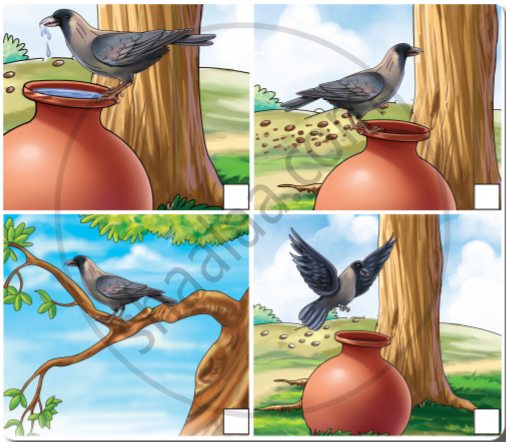
One hot day, a thirsty crow _____________________________________________________________
__________________________________________________________________________________________
The Pooja holidays are about to start. Prasanth and Deepak are friends. Both their families have planned to go on a trip to Munnar. Develop a conversation on how they plan for their trip.
|
Plan:
|
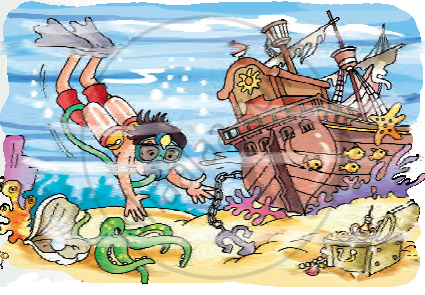
Work in groups of four. See the picture of a shipwreck at the bottom of the ocean.
Suppose you went deep-sea diving. What would you find? Think of all the words that come to your mind, then build a paragraph. Share your story with other groups.
Do your work ______[neat]
I can do the sum ________. [easy}
The grandmother played a vital role in the author’s formative years. Give your own example of how elders have a positive influence on the younger generation. Include examples from the story also.
Why did the friends part ways?
Why did Mary Kom think that she should not return empty-handed?
Why are photographs taken?
| e.g. to freeze our favourite moments | |
Bring out the substance of Basil's letter to Miss Meadows.
Write an original short story that begins with the following words:
My mother stopped suddenly at the doorway and stared in amazement at ..........
