Advertisements
Advertisements
Question
Choose the correct option.
The minor calyx _______.
Options
collects urine
connects pelvis to ureter
is present in the cortex
receives column of Bertini
Advertisements
Solution
The minor calyx collects urine.
APPEARS IN
RELATED QUESTIONS
Match structures given in Column I with functions given in Column II.
| Column I | Column II | ||
| (i) | Stomata | (a) | Absorption of water |
| (ii) | Xylem | (b) | Transpiration |
| (iii) | Root hairs | (c) | Transport of food |
| (iv) | Phloem | (d) | Transport of water |
| (e) | Synthesis of carbohydrates |
The diagram given alongside shows a section of a human kidney. Study the diagram carefully and answer the questions that follow:
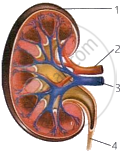
- Label the parts numbered 1 to 4.
- Why does part 2 have a striped appearance?
- What is the fluid that passes down part 4? Name the main nitrogenous waste present in it.
- Mention the structural and functional units of kidneys.
- Name the two major steps in the formation of the fluid mentioned in (c).
What is the role of glomerulus in the kidney?
Name the following:
The tuft of capillaries inside the Bowman's capsule.
Study the diagram given below and then answer the questions that follow:
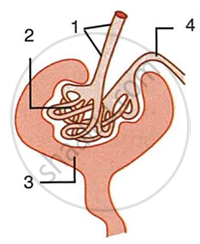 |
- Name the region in the kidney where the above structure is present?
- Name the parts labelled 1, 2, 3 and 4.
- Name the stages involved in the formation of urine.
- What is the technical term given to the process occurring in 2 and 3? Briefly describe the process.
Choose the correct option.
Which one of the following organisms would spend maximum energy in the production of nitrogenous waste?
Answer the following question.
Name any one guanotelic organism.
Complete the diagram/chart with correct labels/ information. Write the conceptual details regarding it.
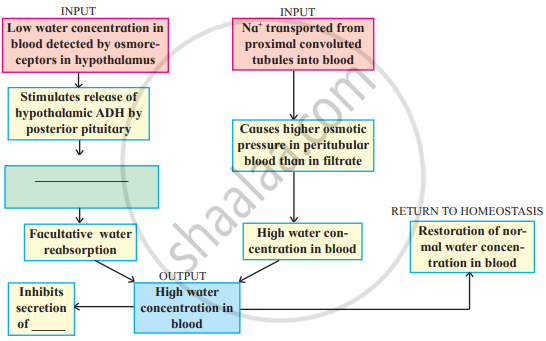
The CORRECT match is ______.
The main nitrogenous waste formed in the human body:
