Advertisements
Advertisements
Question
Answer the following question.
State the role of liver in urea production.
Short/Brief Note
Advertisements
Solution
- Ammonia formed during the breakdown of amino acids is converted into urea in the liver of ureotelic animals.
- This conversion takes place by the help of the ornithine/urea cycle.
- 3 ATP molecules are used to produce one molecule of urea using the ornithine/urea cycle.
Since, the liver contains carrier molecules and enzymes necessary for urea cycle, it plays a major role in urea production.
shaalaa.com
Is there an error in this question or solution?
APPEARS IN
RELATED QUESTIONS
Match structures given in Column I with functions given in Column II.
| Column I | Column II | ||
| (i) | Stomata | (a) | Absorption of water |
| (ii) | Xylem | (b) | Transpiration |
| (iii) | Root hairs | (c) | Transport of food |
| (iv) | Phloem | (d) | Transport of water |
| (e) | Synthesis of carbohydrates |
Draw a diagram of the human excretory system and label the various parts.
Identify the odd one.
Where is urine carried through ureters?
Tick the most appropriate answer.
Quinine is used in the treatment of
Give Technical Term:
The organ which filters out urea and uric acid from the bloodstream.
State the Location: Renal pyramids
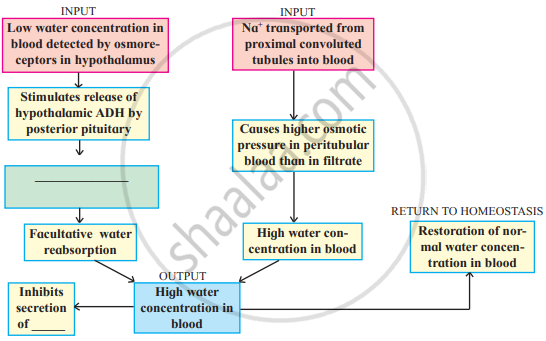
Complete the diagram/chart with correct labels/ information. Write the conceptual details regarding it.
Explain the importance of soil for plant growth.
Give reason:
Excretion is a necessary process of our body.
