Advertisements
Advertisements
Question
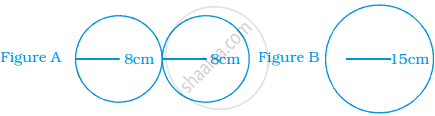
Below are the drawings of cross sections of two different pipes used to fill swimming pools. Figure A is a combination of 2 pipes each having a radius of 8 cm. Figure B is a pipe having a radius of 15 cm. If the force of the flow of water coming out of the pipes is the same in both the cases, which will fill the swimming pool faster?
Advertisements
Solution
In figure A, 2 pipes each having a radius of 8 cm
∵ Area of a circle = πr2
∴ Area of one pipe = `22/7 xx 8 xx 8`
= `(22 xx 8 xx 8)/7`
= `(22 xx 64)/7` cm2
Area of 2 pipes = `(2 xx 1408)/7`
= `2816/7` cm2
= 402.28 cm2
In figure B, a pipe having radius of 15 cm
∴ Area of the pipe = πr2
= `22/7 xx 15 xx 15`
= `22/7 xx 225`
= `4950/7`
= 707.14 cm2
Clearly, the surface area of pipe B is greater. So, pipe B fills the swimming pool faster.
APPEARS IN
RELATED QUESTIONS
Find the volume of a cuboid whose length =1.2 m, breadth = 30 cm, height = 15 cm.
Find the volume in cubic metre (cu. m) of the cuboid whose dimensions is length = 10 m, breadth = 25 dm, height = 50 cm.
A rectangular field is 70 m long and 60 m broad. A well of dimensions 14 m × 8 m × 6 m is dug outside the field and the earth dug-out from this well is spread evenly on the field. How much will the earth level rise?
A field is 150 m long and 100 m wide. A plot (outside the field) 50 m long and 30 m wide is dug to a depth of 8 m and the earth taken out from the plot is spread evenly in the field. By how much is the level of field raised?
A room 5 m long, 4.5 m wide, and 3.6 m high have one door 1.5 m by 2.4 m and two windows, each 1 m by 0.75 m. Find :
(i) the area of its walls, excluding door and windows ;
(ii) the cost of distempering its walls at the rate of Rs.4.50 per m2.
(iii) the cost of painting its roof at the rate of Rs.9 per m2.
The capacity of a rectangular tank is 5.2 m3 and the area of its base is 2.6 x 104 cm2; find its height (depth).
The curved surface area and the volume of a toy, cylindrical in shape, are 132 cm2 and 462 cm3 respectively. Find, its diameter and its length.
The length, breadth, and height of a rectangular solid are in the ratio 6 : 4 :3. If the total surface area is 1728 cm2. Find its dimensions.
A metallic sheet is of the rectangular shape with dimensions 48cm x 36cm. From each one of its corners, a square of 8cm is cutoff. An open box is made of the remaining sheet. Find the volume of the box.
A rectangular sheet of dimensions 25 cm × 7 cm is rotated about its longer side. Find the volume and the whole surface area of the solid thus generated.
