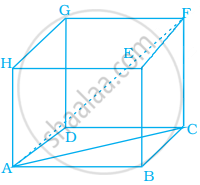
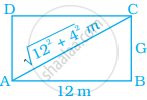
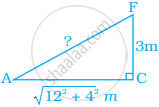
Find the total surface area of the cuboid in length, breadth, and height as given below: 2.5 m, 2 m, 2.4 m
Advertisements
Question
Advertisements
Solution
Length of the cuboid, l = 2.5 cm
Breadth of the cuboid, b = 2 m
Height of the cuboid, h = 2.4 m
The total surface area of the cuboid
= 2(l × b + b × h + l × h)
= 2(2.5 × 2 + 2 × 2.4 + 2.5 × 2.4)
= 2(5 + 4.8 + 6)
= 2 × 15.8
= 31.6 sq.m.
RELATED QUESTIONS
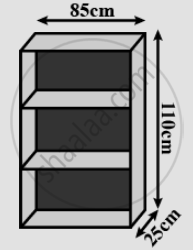
A wooden bookshelf has external dimensions as follows: Height = 110 cm, Depth = 25 cm, Breadth = 85 cm in following figure. The thickness of the plank is 5 cm everywhere. The external faces are to be polished and the inner faces are to be painted. If the rate of polishing is 20 paise per cm2 and the rate of painting is 10 paise per cm2. Find the total expenses required for polishing and painting the surface of the bookshelf.
The volume of a cuboidal box is 48 cm3. If its height and length are 3 cm and 4 cm respectively, find its breadth.
How many planks each of which is 3 m long, 15 cm broad and 5 cm thick can be prepared from a wooden block 6 m long, 75 cm broad and 45 cm thick?
Show that the product of the areas of the floor and two adjacent walls of a cuboid is the square of its volume.
A tank open at the top is made of iron sheet 4 m wide. If the dimensions of the tank are 12 m × 8 m × 6 m, find the cost of iron sheet at Rs 17.50 per metre.
Three equal cubes are placed adjacently in a row. The ratio of the total surface area of the resulting cuboid to that of the sum of the surface areas of three cubes, is
The length, breadth, and height of a room are 6 m, 5.4 m, and 4 m respectively. Find the area of :
(i) its four-walls
(ii) its roof.
Find the length of the largest pole that can be placed in a room of dimensions 12 m × 4 m × 3 m.