Advertisements
Advertisements
प्रश्न
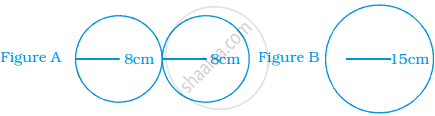
Below are the drawings of cross sections of two different pipes used to fill swimming pools. Figure A is a combination of 2 pipes each having a radius of 8 cm. Figure B is a pipe having a radius of 15 cm. If the force of the flow of water coming out of the pipes is the same in both the cases, which will fill the swimming pool faster?
Advertisements
उत्तर
In figure A, 2 pipes each having a radius of 8 cm
∵ Area of a circle = πr2
∴ Area of one pipe = `22/7 xx 8 xx 8`
= `(22 xx 8 xx 8)/7`
= `(22 xx 64)/7` cm2
Area of 2 pipes = `(2 xx 1408)/7`
= `2816/7` cm2
= 402.28 cm2
In figure B, a pipe having radius of 15 cm
∴ Area of the pipe = πr2
= `22/7 xx 15 xx 15`
= `22/7 xx 225`
= `4950/7`
= 707.14 cm2
Clearly, the surface area of pipe B is greater. So, pipe B fills the swimming pool faster.
APPEARS IN
संबंधित प्रश्न
Daniel is painting the walls and ceiling of a cuboidal hall with length, breadth, and height of 15 m, 10 m, and 7 m, respectively. From each can of paint, 100 m2 of area is painted. How many cans of paint will she need to paint the room?
A cuboid is of dimensions 60 cm × 54 cm × 30 cm. How many small cubes with side 6 cm can be placed in the given cuboid?
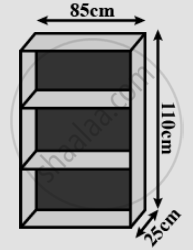
A wooden bookshelf has external dimensions as follows: Height = 110 cm, Depth = 25 cm, Breadth = 85 cm in following figure. The thickness of the plank is 5 cm everywhere. The external faces are to be polished and the inner faces are to be painted. If the rate of polishing is 20 paise per cm2 and the rate of painting is 10 paise per cm2. Find the total expenses required for polishing and painting the surface of the bookshelf.
Find the volume in cubic metre (cu. m) of the cuboid whose dimensions islength = 4 m, breadth = 2.5 m, height = 50 cm.
The walls and ceiling of a room are to be plastered. The length, breadth and height of the room are 4.5 m, 3 m and 350 cm, respectively. Find the cost of plastering at the rate of Rs 8 per square metre.
Find the length of the longest rod that can be placed in a room 12 m long, 9 m broad and 8 m high.
The cost of preparing the walls of a room 12 m long at the rate of Rs 1.35 per square metre is Rs 340.20 and the cost of matting the floor at 85 paise per square metre is Rs 91.80. Find the height of the room.
The sum of the radius and the height of a cylinder is 37 cm and the total surface area of the cylinder is 1628 cm2. Find the height and the volume of the cylinder.
Find the Total Surface Area and the Lateral Surface Area of a cuboid whose dimensions are: length = 20 cm, breadth = 15 cm, height = 8 cm
