Advertisements
Advertisements
Question
Balance the following equation by the oxidation number method.
\[\ce{Cu + HNO3 -> Cu(NO3)2 + NO2 + H2O}\]
Advertisements
Solution
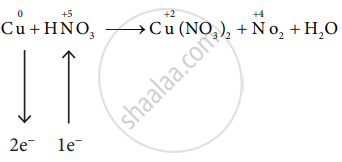
\[\ce{Cu + 2HNO3 -> Cu(NO3)2 + NO2 + H2O}\]
\[\ce{Cu + 2HNO3 + 2HNO3 -> Cu(NO3)2 + 2NO2 + 2H2O}\]
\[\ce{Cu + 4HNO3 -> Cu(NO3)2 + 2NO2 + 2H2O}\]
APPEARS IN
RELATED QUESTIONS
Choose the disproportionation reaction among the following redox reactions.
The correct increasing order of the oxidation state of sulphur in the anions \[\ce{SO^2-_4, SO^2-_3, S2O^2-_4, S2O^2-_6}\] is
Distinguish between oxidation and reduction.
Balance the following equation by the oxidation number method.
\[\ce{K2Cr2O7 + Kl + H2SO4 -> K2SO4 + Cr2(SO4)3 + I2 + H2O}\]
Balance the following equation by the ion electron method.
\[\ce{KMnO4 + SnCl2 + HCl -> MnCl2 + SnCl4 + H2O + KCl}\]
Balance the following equation by the ion electron method.
\[\ce{C2O^2-_4 + Cr2O^2-_7 -> Cr^3+ + CO2}\] (in acid medium)
Which of the following reagents is used for the following conversion?
\[\ce{CH3 - CH = CH - CHO -> CH3 - CH = CH - CH2OH}\]
Which one of the following CANNOT act as a reducing agent?
Which of the following represents a redox reaction?
Which is the best oxidizing agent among the following?
