Advertisements
Advertisements
Question
Balance the following equation by the oxidation number method.
\[\ce{KMnO4 + Na2SO3 -> MnO2 + Na2SO4 + KOH}\]
Advertisements
Solution
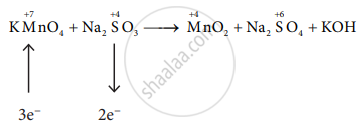
\[\ce{2KMnO4 + 3Na2SO3 -> MnO2 + Na2SO4 + KOH}\]
\[\ce{2KMnO4 + 3Na2SO3 -> 2MnO2 + 3Na2SO4 + KOH}\]
\[\ce{2KMnO4 + 3Na2SO3 + H2O -> 2MnO2 + 3Na2SO4 + 2KOH}\]
APPEARS IN
RELATED QUESTIONS
1 g of an impure sample of magnesium carbonate (containing no thermally decomposable impurities) on complete thermal decomposition gave 0.44 g of carbon dioxide gas. The percentage of impurity in the sample is
Which of the following contains the same number of carbon atoms as in 6 g of carbon-12.
What do you understand by the term oxidation number?
Distinguish between oxidation and reduction.
Balance the following equation by the ion electron method.
\[\ce{KMnO4 + SnCl2 + HCl -> MnCl2 + SnCl4 + H2O + KCl}\]
Balance the following equation by the ion electron method.
\[\ce{C2O^2-_4 + Cr2O^2-_7 -> Cr^3+ + CO2}\] (in acid medium)
Balance the following equation by the ion electron method.
\[\ce{Na2S2O3 + I2 -> Na2S4O6 + NaI}\]
Balance the following equation by the ion electron method.
\[\ce{Zn + NO^-_3 ->Zn^2+ + NO}\] (in acid medium)
Which of the following represents a redox reaction?
Which is the best oxidizing agent among the following?
