Advertisements
Advertisements
Question
Balance the following equation by the oxidation number method.
\[\ce{K2Cr2O7 + Kl + H2SO4 -> K2SO4 + Cr2(SO4)3 + I2 + H2O}\]
Advertisements
Solution
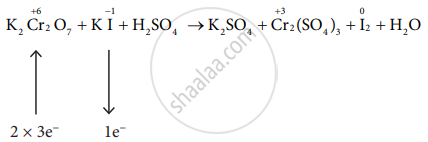
\[\ce{K2Cr2O7 + 6Kl + H2SO4 -> K2SO4 + Cr2(SO4)3 + I2 + H2O}\]
\[\ce{K2Cr2O7 + 6Kl + H2SO4 -> K2SO4 + Cr2(SO4)3 + 3I2 + H2O}\]
\[\ce{K2Cr2O7 + 6Kl + 7H2SO4 -> 4K2SO4 + Cr2(SO4)3 + 3I2 + 7H2O}\]
APPEARS IN
RELATED QUESTIONS
1 g of an impure sample of magnesium carbonate (containing no thermally decomposable impurities) on complete thermal decomposition gave 0.44 g of carbon dioxide gas. The percentage of impurity in the sample is
When 6.3 g of sodium bicarbonate is added to 30 g of acetic acid solution, the residual solution is found to weigh 33 g. The number of moles of carbon dioxide released in the reaction is
Choose the disproportionation reaction among the following redox reactions.
Balance the following equation by the oxidation number method.
\[\ce{KMnO4 + Na2SO3 -> MnO2 + Na2SO4 + KOH}\]
Balance the following equation by the ion electron method.
\[\ce{KMnO4 + SnCl2 + HCl -> MnCl2 + SnCl4 + H2O + KCl}\]
Which of the following reagents is used for the following conversion?
\[\ce{CH3 - CH = CH - CHO -> CH3 - CH = CH - CH2OH}\]
What is the formula of hydrolith?
In the redox reaction, \[\ce{2MnO^-_4 + SO^{2-}_3 + H2O -> 2MnO^{2-}_4 + SO^{2-}_4 + 2H^+}\], the reductant is:
Which one of the following CANNOT act as a reducing agent?
Which of the following represents a redox reaction?
