Advertisements
Advertisements
प्रश्न
Balance the following equation by the oxidation number method.
\[\ce{Cu + HNO3 -> Cu(NO3)2 + NO2 + H2O}\]
Advertisements
उत्तर
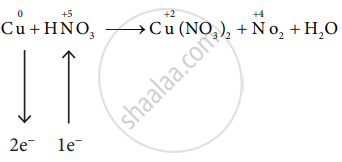
\[\ce{Cu + 2HNO3 -> Cu(NO3)2 + NO2 + H2O}\]
\[\ce{Cu + 2HNO3 + 2HNO3 -> Cu(NO3)2 + 2NO2 + 2H2O}\]
\[\ce{Cu + 4HNO3 -> Cu(NO3)2 + 2NO2 + 2H2O}\]
APPEARS IN
संबंधित प्रश्न
When 6.3 g of sodium bicarbonate is added to 30 g of acetic acid solution, the residual solution is found to weigh 33 g. The number of moles of carbon dioxide released in the reaction is
Total number of electrons present in 1.7 g of ammonia is
The correct increasing order of the oxidation state of sulphur in the anions \[\ce{SO^2-_4, SO^2-_3, S2O^2-_4, S2O^2-_6}\] is
Distinguish between oxidation and reduction.
Hydrogen peroxide is an oxidising agent. It oxidises ferrous ion to ferric ion and reduced itself to water. Write a balanced equation.
Balance the following equation by the oxidation number method.
\[\ce{K2Cr2O7 + Kl + H2SO4 -> K2SO4 + Cr2(SO4)3 + I2 + H2O}\]
Balance the following equation by the ion electron method.
\[\ce{Zn + NO^-_3 ->Zn^2+ + NO}\] (in acid medium)
Reducing agent is a species that ____________.
In the redox reaction, \[\ce{2MnO^-_4 + SO^{2-}_3 + H2O -> 2MnO^{2-}_4 + SO^{2-}_4 + 2H^+}\], the reductant is:
Which one of the following CANNOT act as a reducing agent?
