Advertisements
Advertisements
प्रश्न
Balance the following equation by the oxidation number method.
\[\ce{KMnO4 + H2C2O4 + H2SO4 -> K2SO4 + MnSO4 + CO2 + H2O}\]
Advertisements
उत्तर
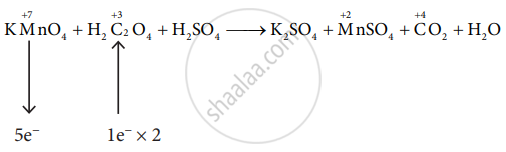
\[\ce{2KMnO4 + 5H2C2O4 + H2SO4 -> K2SO4 + MnSO4 + CO2 + H2O}\]
\[\ce{2KMnO4 + 5H2C2O4 + H2SO4 -> K2SO4 + 2MnSO4 + 10CO2 + H2O}\]
\[\ce{2KMnO4 + 5H2C2O4 + 3H2SO4 -> K2SO4 + 2MnSO4 + 10CO2 + 8H2O}\]
APPEARS IN
संबंधित प्रश्न
Choose the disproportionation reaction among the following redox reactions.
The correct increasing order of the oxidation state of sulphur in the anions \[\ce{SO^2-_4, SO^2-_3, S2O^2-_4, S2O^2-_6}\] is
What do you understand by the term oxidation number?
Distinguish between oxidation and reduction.
Balance the following equation by the oxidation number method.
\[\ce{K2Cr2O7 + Kl + H2SO4 -> K2SO4 + Cr2(SO4)3 + I2 + H2O}\]
Balance the following equation by the oxidation number method.
\[\ce{KMnO4 + Na2SO3 -> MnO2 + Na2SO4 + KOH}\]
Balance the following equation by the oxidation number method.
\[\ce{Cu + HNO3 -> Cu(NO3)2 + NO2 + H2O}\]
Balance the following equation by the ion electron method.
\[\ce{KMnO4 + SnCl2 + HCl -> MnCl2 + SnCl4 + H2O + KCl}\]
Balance the following equation by the ion electron method.
\[\ce{Na2S2O3 + I2 -> Na2S4O6 + NaI}\]
In the cell represented by \[\ce{Pb(s) | Pb^{2+} (1 M) || Ag+ (1 M) | Ag(s)}\], the reducing agent is ______.
