Advertisements
Advertisements
प्रश्न
Balance the following equation by the oxidation number method.
\[\ce{Cu + HNO3 -> Cu(NO3)2 + NO2 + H2O}\]
Advertisements
उत्तर
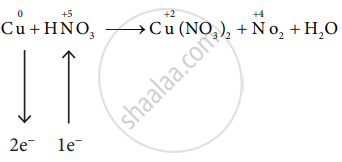
\[\ce{Cu + 2HNO3 -> Cu(NO3)2 + NO2 + H2O}\]
\[\ce{Cu + 2HNO3 + 2HNO3 -> Cu(NO3)2 + 2NO2 + 2H2O}\]
\[\ce{Cu + 4HNO3 -> Cu(NO3)2 + 2NO2 + 2H2O}\]
APPEARS IN
संबंधित प्रश्न
1 g of an impure sample of magnesium carbonate (containing no thermally decomposable impurities) on complete thermal decomposition gave 0.44 g of carbon dioxide gas. The percentage of impurity in the sample is
Choose the disproportionation reaction among the following redox reactions.
The correct increasing order of the oxidation state of sulphur in the anions \[\ce{SO^2-_4, SO^2-_3, S2O^2-_4, S2O^2-_6}\] is
Distinguish between oxidation and reduction.
Balance the following equation by the oxidation number method.
\[\ce{KMnO4 + Na2SO3 -> MnO2 + Na2SO4 + KOH}\]
Balance the following equation by the oxidation number method.
\[\ce{KMnO4 + H2C2O4 + H2SO4 -> K2SO4 + MnSO4 + CO2 + H2O}\]
Balance the following equation by the ion electron method.
\[\ce{Na2S2O3 + I2 -> Na2S4O6 + NaI}\]
Balance the following equation by the ion electron method.
\[\ce{Zn + NO^-_3 ->Zn^2+ + NO}\] (in acid medium)
Reducing agent is a species that ____________.
Which of the following represents a redox reaction?
