Advertisements
Advertisements
Questions
Area of PQRS = Area of PQR + Area of ΔPQS = (6+9.166)𝑐𝑚2=15.166𝑐𝑚2
The sides of a quadrangular field, taken in order are 26 m, 27 m, 7 m are 24 m respectively. The angle contained by the last two sides is a right angle. Find its area.
Advertisements
Solution
The sides of a quadrilateral field taken order as AB = 26m
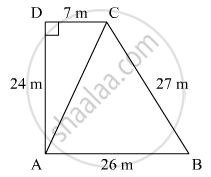
BC = 27 m
CD = 7m and DA = 24 m
Diagonal AC is joined
Now ΔADC
By applying Pythagoras theorem
⇒`AC^2=AD^2+CD^2`
⇒`AC=sqrt(AD^2 +CD^2)`
⇒`AC=sqrt(24^2+7^2)`
⇒`AC=sqrt625=25 m`
Now area of ΔABC
`S=1/2(AB+BC+CA)=1/2(26+27+25)=78/2=39 m`
By using heron’s formula
Area (ΔABC) = `sqrt(S(S-AD)(S_BC)(S-CA))`
`=sqrt(39(39-26)(39-21)(39-25))`
`sqrt(39xx14xx13xx12xx1)`
`=291.849cm^2`
Now for area of ΔADC
`S=1/2(AD+CD+AC)`
`=1/2(25+24+7)=28cm`
By using heron’s formula
`∴ Area of ΔADC = sqrt(S(S-AD)(S-DC)(S-CA))`
`=sqrt(28(28-24)(28-7)(28-25))`
`=84m^2`
∴ Area of rectangular field ABCD = area of ΔABC + area of ΔADC
= `291.849+84`
= `375.8m^2`
APPEARS IN
RELATED QUESTIONS
A rhombus shaped field has green grass for 18 cows to graze. If each side of the rhombus is 30 m and its longer diagonal is 48 m, how much area of grass field will each cow be getting?
The perimeter of a triangullar field is 144 m and the ratio of the sides is 3 : 4 : 5. Find the area of the field.
The base of an isosceles right triangle is 30 cm. Its area is
The base and hypotenuse of a right triangle are respectively 5 cm and 13 cm long. Its area is ______.
The lengths of the sides of Δ ABC are consecutive integers. It Δ ABC has the same perimeter as an equilateral triangle with a side of length 9 cm, what is the length of the shortest side of ΔABC?
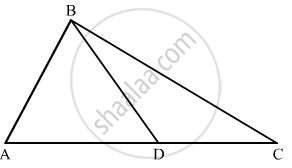
In the given figure, the ratio AD to DC is 3 to 2. If the area of Δ ABC is 40 cm2, what is the area of Δ BDC?
A square and an equilateral triangle have equal perimeters. If the diagonal of the square is \[12\sqrt{2}\] cm, then area of the triangle is
The adjacent sides of a parallelogram measures 34 m, 20 m and the measure of the diagonal is 42 m. Find the area of parallelogram
The area of a regular hexagon of side ‘a’ is the sum of the areas of the five equilateral triangles with side a.
