Advertisements
Advertisements
प्रश्न
Area of PQRS = Area of PQR + Area of ΔPQS = (6+9.166)𝑐𝑚2=15.166𝑐𝑚2
The sides of a quadrangular field, taken in order are 26 m, 27 m, 7 m are 24 m respectively. The angle contained by the last two sides is a right angle. Find its area.
Advertisements
उत्तर
The sides of a quadrilateral field taken order as AB = 26m
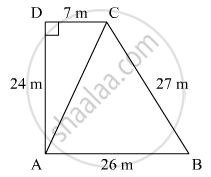
BC = 27 m
CD = 7m and DA = 24 m
Diagonal AC is joined
Now ΔADC
By applying Pythagoras theorem
⇒`AC^2=AD^2+CD^2`
⇒`AC=sqrt(AD^2 +CD^2)`
⇒`AC=sqrt(24^2+7^2)`
⇒`AC=sqrt625=25 m`
Now area of ΔABC
`S=1/2(AB+BC+CA)=1/2(26+27+25)=78/2=39 m`
By using heron’s formula
Area (ΔABC) = `sqrt(S(S-AD)(S_BC)(S-CA))`
`=sqrt(39(39-26)(39-21)(39-25))`
`sqrt(39xx14xx13xx12xx1)`
`=291.849cm^2`
Now for area of ΔADC
`S=1/2(AD+CD+AC)`
`=1/2(25+24+7)=28cm`
By using heron’s formula
`∴ Area of ΔADC = sqrt(S(S-AD)(S-DC)(S-CA))`
`=sqrt(28(28-24)(28-7)(28-25))`
`=84m^2`
∴ Area of rectangular field ABCD = area of ΔABC + area of ΔADC
= `291.849+84`
= `375.8m^2`
APPEARS IN
संबंधित प्रश्न
Find the area of a quadrilateral ABCD in which AB = 3 cm, BC = 4 cm, CD = 4 cm, DA = 5 cm and AC = 5 cm.
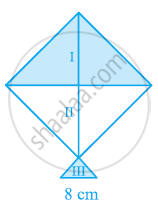
A kite in the shape of a square with a diagonal 32 cm and an isosceles triangles of base 8 cm and sides 6 cm each is to be made of three different shades as shown in the given figure. How much paper of each shade has been used in it?
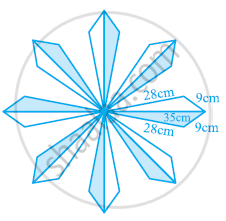
A floral design on a floor is made up of 16 tiles which are triangular, the sides of the triangle being 9 cm, 28 cm and 35 cm (see the given figure). Find the cost of polishing the tiles at the rate of 50p per cm2.
A park, in the shape of a quadrilateral ABCD, has ∠C = 900, AB = 9 m, BC = 12 m, CD = 5 m and AD = 8 m How much area does it occupy?
Find the area of an equilateral triangle having altitude h cm.
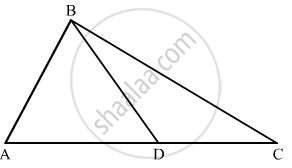
In the given figure, the ratio AD to DC is 3 to 2. If the area of Δ ABC is 40 cm2, what is the area of Δ BDC?
If every side of a triangle is doubled, then increase in the area of the triangle is
A park is in the shape of a quadrilateral. The sides of the park are 15 m, 20 m, 26 m and 17 m and the angle between the first two sides is a right angle. Find the area of the park
The adjacent sides of a parallelogram measures 34 m, 20 m and the measure of the diagonal is 42 m. Find the area of parallelogram
If the area of an equilateral triangle is `16sqrt(3)` cm2, then the perimeter of the triangle is ______.
