Advertisements
Advertisements
Question
Answer the following question.
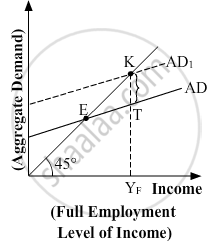
In the given figure, what does the gap 'KT' represent? State any two fiscal measures to correct the situation.
Advertisements
Solution
The gap 'KT' represents the inflationary gap. This is the situation of excess demand.
Fiscal policy refers to the policy that is undertaken by the government to influence the economy through the process of its expenditure and taxation.
The fiscal measures to correct the excess demand are given as follows:
- Government Expenditure: The Government of a country incurs various types of expenditure to enhance the welfare of the people and also to facilitate economic growth and development.
In case of excess demand, the government cuts down its expenditures in the form of disinvestment. This lowers the level of economic activity, which in turn, reduces the level of employment, thereby reducing the income level. This subsequently reduces the aggregate demand, thus, the situation of excess demand gets corrected. - Public Borrowings: Through the measure of public borrowings, the government affects the liquidity (cash balances) held by the public. It is because of the excess liquidity, the people demand more and vice-versa. Therefore, the government affects the liquidity balances with the help of public borrowings.
In the case of excess demand, the government raises public borrowings, which reduces the liquidity balances with the public. A reduction in the liquidity lowers the purchasing power of the people, which in turn, lowers the aggregate demand.
RELATED QUESTIONS
Fiscal deficit equals :
(a) Interest payments
(b) Borrowings
(c) Interest payments less borrowing
(d) Borrowing less interest payments
Define fiscal deficit.
Suppose marginal propensity to consume is 0.75 and there is a 20 per cent proportional income tax. Find the change in equilibrium income for the following (a) Government purchases increase by 20 (b) Transfers decrease by 20.
Explain why the tax multiplier is smaller in absolute value than the government expenditure multiplier.
Explain the relation between government deficit and government debt.
Does public debt impose a burden? Explain.
The primary deficit in a government budget is ______.
______ in the budget is an important measure of deficit.
The difference between fiscal deficit and interest payment is known as ______
How do we get the primary deficit from the fiscal deficit?
If India exports goods worth ₹20 crores and imports goods worth ₹30 crores, it will have a ______
How good is the system of G.S.T as compared to the old tax system?
On the basis of the given information, calculate the value of:
- Fiscal deficit
- Primary deficit
| S.No. | Items | 2021-22 (₹ in crore) |
| (i) | Revenue Receipts | 20 |
| (ii) | Capital Expenditure | 15 |
| (iii) | Revenue Deficit | 10 |
| (iv) | Non-debt creating capital receipts | 50% of revenue receipts |
| (v) | Interest Payments | 4 |
A Budget Deficit refers to a situation where:
The three main measures of government deficit are:
If a government's revenue expenditure is ₹700 crore and its revenue receipts are ₹550 crore, the Revenue Deficit is:
The Fiscal Deficit measures:
The Revenue Deficit is always a part (sub-component) of which deficit?
If the Primary Deficit is zero, it means that:
