Advertisements
Advertisements
प्रश्न
Answer the following question.
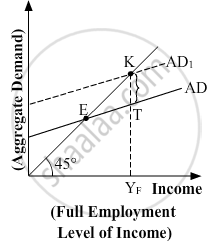
In the given figure, what does the gap 'KT' represent? State any two fiscal measures to correct the situation.
Advertisements
उत्तर
The gap 'KT' represents the inflationary gap. This is the situation of excess demand.
Fiscal policy refers to the policy that is undertaken by the government to influence the economy through the process of its expenditure and taxation.
The fiscal measures to correct the excess demand are given as follows:
- Government Expenditure: The Government of a country incurs various types of expenditure to enhance the welfare of the people and also to facilitate economic growth and development.
In case of excess demand, the government cuts down its expenditures in the form of disinvestment. This lowers the level of economic activity, which in turn, reduces the level of employment, thereby reducing the income level. This subsequently reduces the aggregate demand, thus, the situation of excess demand gets corrected. - Public Borrowings: Through the measure of public borrowings, the government affects the liquidity (cash balances) held by the public. It is because of the excess liquidity, the people demand more and vice-versa. Therefore, the government affects the liquidity balances with the help of public borrowings.
In the case of excess demand, the government raises public borrowings, which reduces the liquidity balances with the public. A reduction in the liquidity lowers the purchasing power of the people, which in turn, lowers the aggregate demand.
संबंधित प्रश्न
Explain 'Revenue Deficit in a Government budget? What does it indicate?
Define revenue
Consider an economy described by the following functions:- C = 20 + 0.80Y, I = 30, G = 50, TR = 100 (a) Find the equilibrium level of income and the autonomous expenditure multiplier in the model. (b) If government expenditure increases by 30, what is the impact on equilibrium income? (c) If a lump-sum tax of 30 is added to pay for the increase in government purchases, how will equilibrium income change?
Are fiscal deficits inflationary?
Suppose you are a member of the "Advisory Committee to the Finance Minister of India". The Finance Minister is concerned about the rising Revenue Deficit in the budget.
Suggest anyone measure to control the rising Revenue Deficit of the government.
Assertion (A): Fiscal deficit is measured in terms of borrowings.
Reason (R): External borrowings increases the Fiscal deficit.
A fiscal deficit is equal to borrowings. It is ______
______ in the budget is an important measure of deficit.
The difference between fiscal deficit and interest payment is known as ______
Which of the following statements are correct
Statement 1: Fiscal deficits are not necessarily inflationary; though, they are generally regarded as inflationary.
Statement 2: When the government expenditure increases and tax reduces, there is a government deficit and there will be a corresponding increase in the aggregate demand.
______ are the transactions between the residents of two countries that take place due to consideration of profit.
Which of the following transactions are correct about ORT?
How do we get the primary deficit from the fiscal deficit?
Compare the trends depicted in the figures given below:
| Figure 1: Trends in Fiscal deficit and Primary deficit |
Figure 2: Fiscal deficit as a percent of Budget estimate |
 |
 |
A large amount of fiscal deficit proves to be counter productive. Give any two reasons in support of this statement.
A Revenue Deficit occurs when:
Which of the following formulas correctly defines the Fiscal Deficit?
Which of the following formulas correctly defines the Primary Deficit?
