Advertisements
Advertisements
प्रश्न
‘The fiscal deficit gives the borrowing requirement of the government’. Elucidate.
Advertisements
उत्तर
Fiscal deficit is the excess of total expenditure over total receipts.
That is, when total government expenditure is greater that total government receipts, the government faces fiscal deficit.
Fiscal deficit is estimated as:-
Total Expenditure (revenue + capital) − Total Receipts (excluding borrowings).
Fiscal deficit gives an indication to the government about the total borrowing requirements from all sources. Fiscal deficit can be financed through domestic borrowings and/or borrowings from abroad. Greater fiscal deficit implies greater borrowings by the government.
APPEARS IN
संबंधित प्रश्न
Fiscal deficit equals :
(a) Interest payments
(b) Borrowings
(c) Interest payments less borrowing
(d) Borrowing less interest payments
Define revenue
Consider an economy described by the following functions:- C = 20 + 0.80Y, I = 30, G = 50, TR = 100 (a) Find the equilibrium level of income and the autonomous expenditure multiplier in the model. (b) If government expenditure increases by 30, what is the impact on equilibrium income? (c) If a lump-sum tax of 30 is added to pay for the increase in government purchases, how will equilibrium income change?
Explain the relation between government deficit and government debt.
Answer the following question.
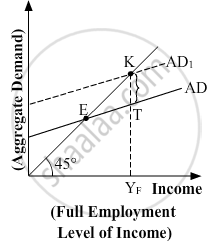
In the given figure, what does the gap 'KT' represent? State any two fiscal measures to correct the situation.
Assertion (A): Fiscal deficit is measured in terms of borrowings.
Reason (R): External borrowings increases the Fiscal deficit.
Read the following statements carefully and choose the correct alternatives given below:
Statement 1: Fiscal Deficit = Total Budget Expenditure - Total Budget Receipts (Net of borrowing)
Statement 2: Primary Deficit = Fiscal Deficit + Interest Payments.
Which of the following statements are correct
Statement 1: Fiscal deficits are not necessarily inflationary; though, they are generally regarded as inflationary.
Statement 2: When the government expenditure increases and tax reduces, there is a government deficit and there will be a corresponding increase in the aggregate demand.
Which of the following transactions are correct about ORT?
How do we get the primary deficit from the fiscal deficit?
If India exports goods worth ₹20 crores and imports goods worth ₹30 crores, it will have a ______
Identify the correctly matched pair of the items in Column A to those in Column B:
| Column A | Column B | ||
| 1 | Fiscal Deficit | (a) | Other than interest payments |
| 2 | Primary Deficit | (b) | Borrowings less interest payments |
| 3 | Revenue Deficit | (c) | Borrowings |
| 4 | Tax Deficit | (d) | Borrowings in government budget |
Which of the following statements is true?
Primary deficit is borrowing requirements of government for making:
On the basis of the given information, calculate the value of:
- Fiscal deficit
- Primary deficit
| S.No. | Items | 2021-22 (₹ in crore) |
| (i) | Revenue Receipts | 20 |
| (ii) | Capital Expenditure | 15 |
| (iii) | Revenue Deficit | 10 |
| (iv) | Non-debt creating capital receipts | 50% of revenue receipts |
| (v) | Interest Payments | 4 |
The three main measures of government deficit are:
A Revenue Deficit occurs when:
For 2024–25 Budget Estimates, the fiscal deficit was estimated at what percentage of GDP?
Which of the following formulas correctly defines Revenue Receipts?
