Advertisements
Advertisements
प्रश्न
Explain why the tax multiplier is smaller in absolute value than the government expenditure multiplier.
Advertisements
उत्तर
The tax multiplier is smaller in absolute value than the government expenditure multiplier, as the government expenditure affects the total expenditure and taxes through the multiplier. Tax multiplier also influences disposable income that affects the overall consumption level.
The reason is explained through the following example.
Let’s assume MPC be to 0.80.
Then, the government expenditure multiplier `=1/(1-c)`
`=1/(1-0.80)`
`=1/0.20=5`
Tax multiplier `=(-c)/(1-c)=(-0.80)/(1-0.80)`
`=(-0.80)/0.20=-4`
This shows that government expenditure multiplier is more than tax multiplier.
APPEARS IN
संबंधित प्रश्न
Define fiscal deficit.
Suppose that for a particular economy, investment is equal to 200, government purchases are 150, net taxes (that is lump-sum taxes minus transfers) is 100 and consumption is given by C = 100 + 0.75Y (a) What is the level of equilibrium income? (b) Calculate the value of the government expenditure multiplier and the tax multiplier. (c) If government expenditure increases by 200, find the change in equilibrium income.
What do you understand by G.S.T?
Answer the following question.
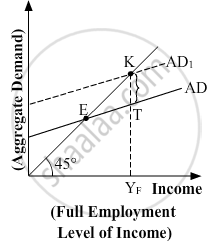
In the given figure, what does the gap 'KT' represent? State any two fiscal measures to correct the situation.
Suppose you are a member of the "Advisory Committee to the Finance Minister of India". The Finance Minister is concerned about the rising Revenue Deficit in the budget.
Suggest anyone measure to control the rising Revenue Deficit of the government.
Fiscal deficit = ______.
The primary deficit in a government budget is ______.
Read the following statements carefully and choose the correct alternatives given below:
Statement 1: Fiscal Deficit = Total Budget Expenditure - Total Budget Receipts (Net of borrowing)
Statement 2: Primary Deficit = Fiscal Deficit + Interest Payments.
A fiscal deficit is equal to borrowings. It is ______
______ in the budget is an important measure of deficit.
Which of the following statements are correct
Statement 1: Fiscal deficits are not necessarily inflationary; though, they are generally regarded as inflationary.
Statement 2: When the government expenditure increases and tax reduces, there is a government deficit and there will be a corresponding increase in the aggregate demand.
Which of the following points are related to the current alarm?
The shape of average revenue curve in monopoly is ______
On the basis of the given information, calculate the value of:
- Fiscal deficit
- Primary deficit
| S.No. | Items | 2021-22 (₹ in crore) |
| (i) | Revenue Receipts | 20 |
| (ii) | Capital Expenditure | 15 |
| (iii) | Revenue Deficit | 10 |
| (iv) | Non-debt creating capital receipts | 50% of revenue receipts |
| (v) | Interest Payments | 4 |
A large amount of fiscal deficit proves to be counter productive. Give any two reasons in support of this statement.
Which of the following formulas correctly defines the Revenue Deficit?
If a government's revenue expenditure is ₹700 crore and its revenue receipts are ₹550 crore, the Revenue Deficit is:
The Fiscal Deficit measures:
For 2024–25 Budget Estimates, the fiscal deficit was estimated at what percentage of GDP?
