Advertisements
Advertisements
प्रश्न
Are fiscal deficits inflationary?
Advertisements
उत्तर
Fiscal deficits are not necessarily inflationary; though, they are generally regarded as inflationary. When the government expenditure increases and tax reduces, there is a government deficit and there will be a corresponding increase in the aggregate demand. However, the firms might not be able to meet the growing demands, forcing the price to rise. Hence fiscal deficits are inflationary in this sense.
But on the other hand, initially if the resources are underutilised (due to insufficient demand) and output is below full employment level, then with the increase in government expenditure, more factor resources will be employed to cater to the increasing demand without exerting much pressure on price to rise. In this situation, a high fiscal deficit is accompanied by high demand, greater output level and lesser inflationary situation. Hence, whether the fiscal deficits are inflationary or not depends on how close is the original output level to the full employment level.
APPEARS IN
संबंधित प्रश्न
Define fiscal deficit.
Give the relationship between the revenue deficit and the fiscal deficit.
Suppose that for a particular economy, investment is equal to 200, government purchases are 150, net taxes (that is lump-sum taxes minus transfers) is 100 and consumption is given by C = 100 + 0.75Y (a) What is the level of equilibrium income? (b) Calculate the value of the government expenditure multiplier and the tax multiplier. (c) If government expenditure increases by 200, find the change in equilibrium income.
Consider an economy described by the following functions:- C = 20 + 0.80Y, I = 30, G = 50, TR = 100, calculate the effect on output of a 10 per cent increase in transfers, and a 10 per cent increase in lump-sum taxes. Compare the effects of the two.
Suppose marginal propensity to consume is 0.75 and there is a 20 per cent proportional income tax. Find the change in equilibrium income for the following (a) Government purchases increase by 20 (b) Transfers decrease by 20.
Does public debt impose a burden? Explain.
Answer the following question.
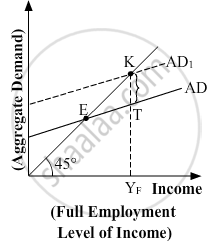
In the given figure, what does the gap 'KT' represent? State any two fiscal measures to correct the situation.
______ are the transactions between the residents of two countries that take place due to consideration of profit.
Which of the following transactions are correct about ORT?
How good is the system of G.S.T as compared to the old tax system?
On the basis of the given information, calculate the value of:
- Fiscal deficit
- Primary deficit
| S.No. | Items | 2021-22 (₹ in crore) |
| (i) | Revenue Receipts | 20 |
| (ii) | Capital Expenditure | 15 |
| (iii) | Revenue Deficit | 10 |
| (iv) | Non-debt creating capital receipts | 50% of revenue receipts |
| (v) | Interest Payments | 4 |
A Budget Deficit refers to a situation where:
If a government's revenue expenditure is ₹700 crore and its revenue receipts are ₹550 crore, the Revenue Deficit is:
Which of the following formulas correctly defines the Fiscal Deficit?
The Primary Deficit shows the borrowing requirement of the government:
Which of the following formulas correctly defines the Primary Deficit?
For 2024–25 Budget Estimates, the fiscal deficit was estimated at what percentage of GDP?
Which of the following formulas correctly defines Revenue Receipts?
