Advertisements
Advertisements
प्रश्न
Consider an economy described by the following functions:- C = 20 + 0.80Y, I = 30, G = 50, TR = 100, calculate the effect on output of a 10 per cent increase in transfers, and a 10 per cent increase in lump-sum taxes. Compare the effects of the two.
Advertisements
उत्तर
MPC = 0.80
`barC` = 20
I = 30
G = 50
TR = 100
ΔTR = 10
Equilibrium level of income `=1/(1-c)[barC+cTR+I+G+DeltaTR]`
`=1/(1-0.80)[20+0.80xx100+30+50+0.80xx10]`
`=188/0.20xx100="Rs." 940`
Change in income = 940 − 900 = Rs 40
Increase in lump-sum tax ΔT =10
Change in Income `=DeltaT(-c)/(1-c)`
`=-10xx0.80/0.20`
= -10 × 4
=-40
From the above results, we can conclude that increase of 10 percent in transfers will raise the income by 40%.
And, increase of 10% in tax will lead to a fall in the income by 40%.
APPEARS IN
संबंधित प्रश्न
Define fiscal deficit.
Explain the relation between government deficit and government debt.
Are fiscal deficits inflationary?
Answer the following question.
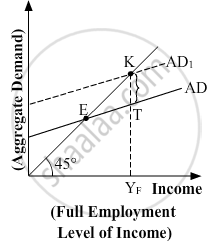
In the given figure, what does the gap 'KT' represent? State any two fiscal measures to correct the situation.
Regressive tax is that which is ______.
The primary deficit in a government budget is ______.
Assertion (A): Fiscal deficit is measured in terms of borrowings.
Reason (R): External borrowings increases the Fiscal deficit.
______ in the budget is an important measure of deficit.
The difference between fiscal deficit and interest payment is known as ______
______ are those transactions that are undertaken to cover deficit or surplus in autonomous transactions.
Which of the following points are related to the current alarm?
Fiscal deficit equals:
The shape of average revenue curve in monopoly is ______
On the basis of the given information, calculate the value of:
- Fiscal deficit
- Primary deficit
| S.No. | Items | 2021-22 (₹ in crore) |
| (i) | Revenue Receipts | 20 |
| (ii) | Capital Expenditure | 15 |
| (iii) | Revenue Deficit | 10 |
| (iv) | Non-debt creating capital receipts | 50% of revenue receipts |
| (v) | Interest Payments | 4 |
A Budget Deficit refers to a situation where:
If a government's revenue expenditure is ₹700 crore and its revenue receipts are ₹550 crore, the Revenue Deficit is:
Which of the following formulas correctly defines the Primary Deficit?
For 2024–25 Budget Estimates, the fiscal deficit was estimated at what percentage of GDP?
The Primary Deficit is always smaller than the Fiscal Deficit because:
