Advertisements
Advertisements
प्रश्न
Explain 'Revenue Deficit in a Government budget? What does it indicate?
What is revenue deficit in government budget?
Explain the meaning of Revenue deficit
What is revenue deficit?
Define revenue deficit
Advertisements
उत्तर
Revenue deficit means the excess of revenue expenditure of the government over its revenue receipts.
Revenue deficit = Revenue expenditure − Revenue receipts
Revenue deficit is indicated to the government as follows:
- Regular receipts of the government are not enough to meet regular expenditures.
- The government is using up savings of other sectors of the economy to meet its consumption expenditure.
- This gives a signal to either reduce its expenditure or increase its revenue. Curtail expenditure by taking steps to avoid unproductive expenses and increase revenue from various sources of tax and non-tax revenues
APPEARS IN
संबंधित प्रश्न
Distinguish between revenue deficit and fiscal deficit.
Consider an economy described by the following functions:- C = 20 + 0.80Y, I = 30, G = 50, TR = 100, calculate the effect on output of a 10 per cent increase in transfers, and a 10 per cent increase in lump-sum taxes. Compare the effects of the two.
Suppose marginal propensity to consume is 0.75 and there is a 20 per cent proportional income tax. Find the change in equilibrium income for the following (a) Government purchases increase by 20 (b) Transfers decrease by 20.
Answer the following question.
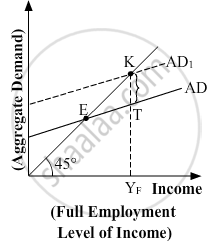
In the given figure, what does the gap 'KT' represent? State any two fiscal measures to correct the situation.
Classify the following statement into positive economic or normative economic, with suitable reason:
Government should try to control the rising fiscal deficit.
Assertion (A): Fiscal deficit is measured in terms of borrowings.
Reason (R): External borrowings increases the Fiscal deficit.
Read the following statements carefully and choose the correct alternatives given below:
Statement 1: Fiscal Deficit = Total Budget Expenditure - Total Budget Receipts (Net of borrowing)
Statement 2: Primary Deficit = Fiscal Deficit + Interest Payments.
______ in the budget is an important measure of deficit.
______ are the transactions between the residents of two countries that take place due to consideration of profit.
______ are those transactions that are undertaken to cover deficit or surplus in autonomous transactions.
How do we get the primary deficit from the fiscal deficit?
Primary deficit is borrowing requirements of government for making:
Fiscal Deficit equals:
The shape of average revenue curve in monopoly is ______
Compare the trends depicted in the figures given below:
| Figure 1: Trends in Fiscal deficit and Primary deficit |
Figure 2: Fiscal deficit as a percent of Budget estimate |
 |
 |
A large amount of fiscal deficit proves to be counter productive. Give any two reasons in support of this statement.
The Primary Deficit shows the borrowing requirement of the government:
Which of the following formulas correctly defines Revenue Receipts?
