Advertisements
Advertisements
Question
What is the photoelectric effect?
Advertisements
Solution
The phenomenon of the emission of electrons from a metal surface when electromagnetic radiation of the appropriate frequency is incident on it is known as the photoelectric effect.
RELATED QUESTIONS
Choose the correct option.
Polychromatic (containing many different frequencies) radiation is used in an experiment on the photoelectric effect. The stopping potential ______.
The threshold wavelength of tungsten is 2.76 x 10⁻⁵ cm.
(a) Explain why no photoelectrons are emitted when the wavelength is more than 2.76 x 10⁻⁵ cm.
(b) What will be the maximum kinetic energy of electrons ejected in each of the following cases
(i) if ultraviolet radiation of wavelength λ = 1.80 × 10⁻⁵ cm and
(ii) radiation of frequency 4 x 10¹⁵ Hz is made incident on the tungsten surface?
The minimum frequency for photoelectric effect on metal is 7 × 10¹⁴ Hz, Find the work function of the metal.
Explain the concept of the photoelectric effect.
If the total energy of radiation of frequency 1014 Hz is 6.63 J, Calculate the number of photons in the radiation.
State Einstein photoelectric equation.
With the help of a circuit diagram describing an experiment to study the photoelectric effect.
The energy of a photon is 2 eV. Find its frequency and wavelength.
The energy of the incident photon on the metal surface is 3 W and then 5 W, where W is the work function for that metal. The ratio of velocities of emitted photoelectrons is ______.
The maximum velocity of the photoelectron emitted by the metal surface is 'v '. Charge and mass of the photoelectron is denoted by 'e' and 'm' respectively. The stopping potential in volt is ______.
The work function of a metal is 1.6 x 10⁻¹⁹ J. When the metal surface is illuminated by the light of wavelength 6400 Å, then the maximum kinetic energy of emitted photo-electrons will be (Planck's constant h = 6.4 x 10⁻³⁴ Js) ____________.
In photoelectric experiment, if both the intensity and frequency of the incident light are doubled, then the saturation of photoelectric current ______.
A metal surface is illuminated by photons of energy 5 eV and 2.5 eV respectively. The ratio of their wavelengths is ____________.
When certain metal surface is illuminated with a light of wavelength A., the stopping potential is V, When the same surface is illuminated by light of wavelength 2λ, the stopping potential is `("V"/3)`. The threshold wavelength for the surface is ______.
When a surface 1 cm thick is illuminated by light of wavelength 'λ', the stopping potential is 'V0'. When the same surface is illuminated by light of wavelength '3λ', the stopping potential is `"V"_0/6`. The threshold wavelength for the metallic surface is ______.
The photon of frequency vis incident on a metal surface whose threshold frequency is v0. The kinetic energy of the emitted photoelectrons will be ____________.
The radiations of energies 1 eV and 2.5 eV are incident on a metal surface having work function 0.5 eV. The ratio of the maximum velocities of the emitted photo-electrons is ____________.
When a metal with work function 0.6 eV is illuminated with light of energy 2 eV, the stopping potential will be ____________.
An electromagnetic wave of wavelength '`lambda`' is incident on a photosensitive surface of negligible work function. If the photoelectrons emitted from this surface have the de-Broglie wavelength '`lambda_1`' then ____________.
The ratio of slopes m1: ro2 of the lines given in the following graphs is, ______.
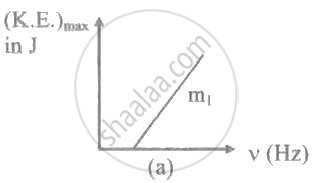
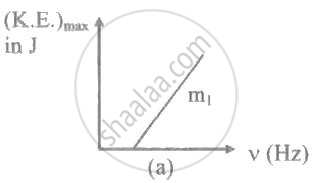
When the work function of a metal increases, maximum kinetic energy of emitted photoelectrons ____________.
For a given photosensitive material and frequency (> threshold frequency) of incident radiation, the photoelectric current varies with the intensity of incident light as:
Two radiations of photons energies 1 eV and 2.5 eV, successively illuminate a photosensitive metallic surface of work function 0.5 eV. The ratio of the maximum speeds of the emitted electrons is ______.
Light of two different frequencies whose photons have energies 1.3 eV and 2.8 eV respectively, successfully illuminate a metallic surface whose work function is 0.8 eV. The ratio of maximum speeds of emitted electrons will be ______.
The photoelectric threshold for a certain metal surface is 3600 Å. If the metal surface is irradiated by a wavelength of 1100 Å, then kinetic energy of the emitted photoelectrons is ______.
Give Einstein's explanation of the photoelectric effect.
The threshold frequency for a certain metal for photoelectric effect is 1.7 x 10¹⁵ Hz. When a light of frequency 2.2 x 10¹⁵ Hz is incident on the metal surface, the kinetic energy of the emitted photoelectrons is 3.3 x.10-19 J. Calculate Planck's constant.
In a photoelectric experiment, the stopping potential is 1.5V. What is the maximum kinetic energy of a photoelectron?
