Advertisements
Advertisements
Question
Can microwaves be used in the experiment on photoelectric effect?
Advertisements
Solution
No, using microwaves in the photoelectric effect experiment is not possible.
The microwave frequency is in the range of 109 Hz to 1012 Hz. This frequency range is insufficient to provide energy for the photoelectric effect.
APPEARS IN
RELATED QUESTIONS
Choose the correct option.
Polychromatic (containing many different frequencies) radiation is used in an experiment on the photoelectric effect. The stopping potential ______.
What is the photoelectric effect?
Explain the inverse linear dependence of stopping potential on the incident wavelength in a photoelectric effect experiment.
Using the values of work function given in the following table, tell which metal will require the highest frequency of incident radiation to generate photocurrent.
Typical values of work function for some common metals
| Metal | Work function (in eV) |
| Potassium | 2.3 |
| Sodium | 2.4 |
| Calcium | 2.9 |
| Zinc | 3.6 |
| Silver | 4.3 |
| Aluminium | 4.3 |
| Tungsten | 4.5 |
| Copper | 4.7 |
| Nickel | 5.0 |
| Gold | 5.1 |
Radiation of wavelength 4500 Å is incident on a metal having work function 2.0 eV. Due to the presence of a magnetic field B, the most energetic photoelectrons emitted in a direction perpendicular to the field move along a circular path of radius 20 cm. What is the value of the magnetic field B?
As the intensity of incident light increases ______
The maximum kinetic energy of the photoelectrons depends only on ______
Define photoelectric effect.
The minimum frequency for photoelectric effect on metal is 7 × 10¹⁴ Hz, Find the work function of the metal.
With the help of a circuit diagram describing an experiment to study the photoelectric effect.
The energy of a photon is 2 eV. Find its frequency and wavelength.
The maximum velocity of the photoelectron emitted by the metal surface is v. Charge and the mass of the photoelectron is denoted by e and m, respectively. The stopping potential in volt is ______.
The energy of the incident photon on the metal surface is 3 W and then 5 W, where W is the work function for that metal. The ratio of velocities of emitted photoelectrons is ______.
The following graph shows the stopping potential V0 versus frequency v for photoelectric emission from two metals A and B. The slope of each of the lines gives ______

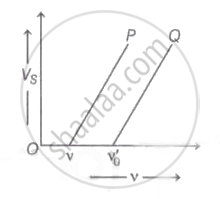
The graph of stopping potential `"V"_"s"` against frequency v of incident radiation is plotted for two different metals P and Q as shown in the graph. ΦP and ΦQ are work-functions of P and Q respectively, then
A metal surface is illuminated by light of given intensity and frequency to cause photoemission. If the intensity of illumination is reduced to one-fourth of its original value then the maximum KE of the emitted photoelectrons would be ______.
An important spectral emission line has a wavelength of 21 cm. The corresponding photon energy is (h = 6.62 x 10⁻³⁴ Js, c = 3 x 10⁸ m/s) ____________.
Threshold wavelength for lithium metal is 6250 Å. For photoemission, the wavelength of the incident light must be ______.
The threshold frequency for a certain photosensitive metal is v0. When it is illuminated by light of frequency v = 2v0, the maximum velocity of photoelectrons is v0. What will be the maximum velocity of the photoelectrons when the same metal is illuminated by light of frequency
v = 5v0?
Light of frequency 2 times the threshold frequency is incident on a photo sensitive material. If the frequency is made `1/3`rd and intensity is doubled then the photocurrent will ______.
The photo electric effect to take place for a metal, the minimum frequency required is 5.792 × 10¹⁴ Hz. A light of wavelength 6000 Å is incident on that metal surface. What is the corresponding frequency of light and will there be photoelectric emissions? [velocity of light = 3 × 10⁸ m/s]
When a metal with work function 0.6 eV is illuminated with light of energy 2 eV, the stopping potential will be ____________.
A metal surface having work function 'w0' emits photoelectrons when photons of energy 'E' are incident on it. The electron enters the uniform magnetic field (B) in perpendicular direction and moves in circular path of radius 'r'. Then 'r' is equal to (m and e be the mass and charge of electron respectively) ____________.
The ratio of slopes m1: ro2 of the lines given in the following graphs is, ______.
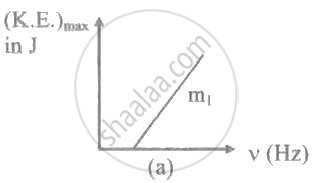
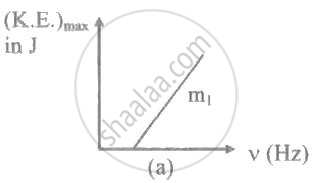
When the work function of a metal increases, maximum kinetic energy of emitted photoelectrons ____________.
In a photoelectric experiment, ultraviolet light of wavelength 280 nm is used with a lithium cathode having work function Φ = 2.5 eV. If the wavelength of incident light is switched to 400 nm, find out the change in the stopping potential.
(h = 6.63 × 10⁻³⁴ Js, c = 3 × 10⁸ ms-1)
When radiation of wavelength λ is used to illuminate a metallic surface, the stopping potential is V. When the same surface is illuminated with radiation of wavelength 3λ, the stopping potential is `"V"/4`. If the threshold wavelength for the metallic surface is nλ. then value of n will be ______.
The wavelength of light incident on a metal surface is reduced from 300 nm to 200 nm (both are less than threshold wavelength). What is the change in the stopping potential for photoelectrons emitted from the surface will be ______ V. (Take h = 6.6 × 10⁻³⁴ J-s)
We wish to observe an object which is 2.5Å in size. The minimum energy photon that can be used ______.
A point isotropic light source of power P = 12 watts is located on the axis of a circular mirror of radius R = 3 cm. If the distance of the source from the centre of the mirror is a = 39 cm and the reflection coefficient of the mirror is α = 0.70 then the force exerted by the light ray on the mirror is ______ × 10-10 N.
