Advertisements
Advertisements
Questions
Answer in brief.
Using differential equations of linear S.H.M, obtain the expression for (a) velocity in S.H.M., (b) acceleration in S.H.M.
State the differential equation of linear S.H.M. Hence, obtain the expression for:
- acceleration
- velocity
Advertisements
Solution
Differential equation of SHM
∴ `(d^2x)/(dt^2) + omega^2.x = 0` ............(i)
(a) Obtaining expression for acceleration:
`(d^2x)/(dt^2) = -omega^2.x` ........[From (i)]
But `a = (d^2x)/(dt^2)` is the acceleration of the particle performing SHM.
∴ a = `-omega^2.x`
This is the expression for acceleration.
(b) Obtaining expression for velocity:
`(d^2x)/(dt^2) = -omega^2.x` ..............[From (i)]
∴ `d/dt((dx)/(dt)) = -omega^2.x`
∴ `(d"v")/(dt) = -omega^2.x`
∴ `(d"v")/(dx)(dx)/(dt) = -omega^2.x`
∴ v`(d"v")/(dx) = -omega^2.x`
∴ v.dv = -ω2.x.dx
Integrating both sides, we get
`int"v".d"v" = -omega^2intx.dx`
∴ `"v"^2/2 = -omega^2.x^2/2 + C` ...........(iii)
Where C is the constant of integration.
Let A be the maximum displacement (amplitude) of the particle in SHM.
When the particle is at an extreme position, velocity (v) is zero,
Thus, at x = ±A, v = 0,
Substituting v = 0 and x = ±A in equation (ii), we get
∴ `0 = -omega^2. A^2/2 + C`
∴ C = `omega^2.A^2/2`
Using the value of C in equation (ii), we get
∴ `"v"^2/2 = -omega^2.x^2/2 + omega^2.A^2/2`
∴ `"v"^2 = omega^2(A^2 - x^2)`
∴ v = `±omegasqrt(A^2 - x^2)`
This is the expression for velocity.
RELATED QUESTIONS
Choose the correct option:
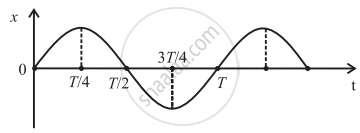
The graph shows variation of displacement of a particle performing S.H.M. with time t. Which of the following statements is correct from the graph?
Acceleration of a particle executing S.H.M. at its mean position.
Using the differential equation of linear S.H.M., obtain an expression for acceleration, velocity, and displacement of simple harmonic motion.
For a particle performing SHM when displacement is x, the potential energy and restoring force acting on it is denoted by E and F, respectively. The relation between x, E and F is ____________.
Two identical wires of substances 'P' and 'Q ' are subjected to equal stretching force along the length. If the elongation of 'Q' is more than that of 'P', then ______.
A particle is moving along a circular path of radius 6 m with a uniform speed of 8 m/s. The average acceleration when the particle completes one-half of the revolution is ______.
The relation between time and displacement for two particles is given by Y1 = 0.06 sin 27`pi` (0.04t + `phi_1`), y2 = 0.03sin 27`pi`(0.04t + `phi_2`). The ratio of the intensity of the waves produced by the vibrations of the two particles will be ______.
The displacement of a particle is 'y' = 2 sin `[(pit)/2 + phi]`, where 'y' is cm and 't' in second. What is the maximum acceleration of the particle executing simple harmonic motion?
(Φ = phase difference)
The maximum speed of a particle in S.H.M. is 'V'. The average speed is ______
The bob of a simple pendulum is released at time t = 0 from a position of small angular displacement. Its linear displacement is ______.
(l = length of simple pendulum and g = acceleration due to gravity, A = amplitude of S.H.M.)
The displacements of two particles executing simple harmonic motion are represented as y1 = 2 sin (10t + θ) and y2 = 3 cos 10t. The phase difference between the velocities of these waves is ______.
A body perform linear simple harmonic motion of amplitude 'A'. At what displacement from the mean position, the potential energy of the body is one fourth of its total energy?
A particle is performing SHM starting extreme position, graphical representation shows that between displacement and acceleration there is a phase difference of ______.
A particle of mass 5 kg moves in a circle of radius 20 cm. Its linear speed at a time t is given by v = 4t, t is in the second and v is in ms-1. Find the net force acting on the particle at t = 0.5 s.
The displacement of a particle of mass 3 g executing simple harmonic motion is given by Y = 3 sin (0.2 t) in SI units. The kinetic energy of the particle at a point which is at a distance equal to `1/3` of its amplitude from its mean position is ______.
A body of mass 0.5 kg travels in a straight line with velocity v = ax3/2 where a = 5 m–1/2s–1. The change in kinetic energy during its displacement from x = 0 to x = 2 m is ______.
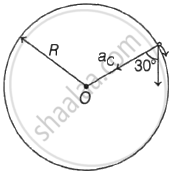
In the given figure, a = 15 m/s2 represents the total acceleration of a particle moving in the clockwise direction on a circle of radius R = 2.5 m at a given instant of time. The speed of the particle is ______.
For a particle performing circular motion, when is its angular acceleration directed opposite to its angular velocity?
A body is suspended from the two light springs separately, the periods of vertical oscillations are \[T_1\] and \[T_2\]. The same body is suspended from two springs connected in series first and then in parallel. The periods of oscillations in both cases respectively are ______.
A particle performs simple harmonic motion with amplitude A. Its speed is tripled at the instant that it is at a distance `(2 A)/3` from equilibrium position. The new amplitude of the motion is ______.
