Advertisements
Advertisements
Question
Find the change in length of a second’s pendulum, if the acceleration due to gravity at the place changes from 9.75 m/s2 to 9.8 m/s2.
Advertisements
Solution
Data: gf =9.75 m/s2 , g2 = 9.8 m/s2
Length of a seconds pendulum, L = `"g"/π^2`
∴ L1 = `"g"_1/"π"^2=9.75/9.872` = 0.9876 m
and L2 = `"g"_2/π^2=9.8/9.872` = 0.9927 m
Find the change in length
ΔL = L2 − L1
= 0.9927 − 0.9876
= 0.0051 m = 5.1 mm
∴ The length of the second's pendulum must be increased from 0.9876 m to 0.9927 m, i.e., by 0.0051 m.
APPEARS IN
RELATED QUESTIONS
A particle is performing simple harmonic motion with amplitude A and angular velocity ω. The ratio of maximum velocity to maximum acceleration is ______.
A particle is performing S.H.M. of amplitude 5 cm and period of 2s. Find the speed of the particle at a point where its acceleration is half of its maximum value.
For a particle performing SHM when displacement is x, the potential energy and restoring force acting on it is denoted by E and F, respectively. The relation between x, E and F is ____________.
The displacement of a particle from its mean position (in metre) is given by, y = 0.2 sin(10 πt + 1.5π) cos(10 πt + 1.5π).
The motion of particle is ____________.
In U.C.M., when time interval δt → 0, the angle between change in velocity (δv) and linear velocity (v) will be ______.
The relation between time and displacement for two particles is given by Y1 = 0.06 sin 27`pi` (0.04t + `phi_1`), y2 = 0.03sin 27`pi`(0.04t + `phi_2`). The ratio of the intensity of the waves produced by the vibrations of the two particles will be ______.
If 'α' and 'β' are the maximum velocity and maximum acceleration respectively, of a particle performing linear simple harmonic motion, then the path length of the particle is _______.
Which of the following represents the acceleration versus displacement graph of SHM?
A particle executing S.H.M. has amplitude 0.01 m and frequency 60 Hz. The maximum acceleration of the particle is ____________.
A body of mass 5 g is in S.H.M. about a point with amplitude 10 cm. Its maximum velocity is 100 cm/s. Its velocity will be 50 cm/s at a distance of, ____________.
The displacement of a particle is 'y' = 2 sin `[(pit)/2 + phi]`, where 'y' is cm and 't' in second. What is the maximum acceleration of the particle executing simple harmonic motion?
(Φ = phase difference)
The maximum speed of a particle in S.H.M. is 'V'. The average speed is ______
The bob of a simple pendulum is released at time t = 0 from a position of small angular displacement. Its linear displacement is ______.
(l = length of simple pendulum and g = acceleration due to gravity, A = amplitude of S.H.M.)
The displacement of the particle performing S.H.M. is given by x = 4 sin πt, where x is in cm and t is in second. The time taken by the particle in second to move from the equilibrium position to the position of half the maximum displacement, is ______.
`[sin30^circ=cos60^circ=0.5, cos30^circ=sin60^circ=sqrt3/2]`
The displacement of a particle in S.H.M. is x = A cos `(omegat+pi/6).` Its speed will be maximum at time ______.
The displacement of a particle is represented by the equation `y = 3 cos (pi/4 - 2ωt)`. The motion of the particle is ______.
A particle is performing SHM starting extreme position, graphical representation shows that between displacement and acceleration there is a phase difference of ______.
A particle performs linear SHM at a particular instant, velocity of the particle is 'u' and acceleration is a while at another instant velocity is 'v' and acceleration is 'β (0 < α < β). The distance between the two position is ______.
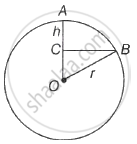
In figure, a particle is placed at the highest point A of a smooth sphere of radius r. It is given slight push and it leaves the sphere at B, at a depth h vertically below A, such that h is equal to ______.
A spring of force constant of 400 N/m is loaded with a mass of 0.25 kg. The amplitude of oscillations is 4 cm. When mass comes to the equilibrium position. Its velocity is ______.
State the expression for the total energy of SHM in terms of acceleration.
Which one of the following is not a characteristics of SHM?
A particle executing SHM has velocities v1 and v2 when it is at distance x1 and x2 from the centre of the path. Show that the time period is given by `T=2pisqrt((x_2^2-x_1^2)/(v_1^2-v_2^2))`
A particle performs simple harmonic motion with amplitude A. Its speed is tripled at the instant that it is at a distance `(2 A)/3` from equilibrium position. The new amplitude of the motion is ______.
A pendulum is performing simple harmonic motion. The acceleration of the bob is 20 cm s−2 at a distance of 5 cm from mean position. The time period of oscillation is ______.
