Advertisements
Advertisements
प्रश्न
Answer in brief.
Using differential equations of linear S.H.M, obtain the expression for (a) velocity in S.H.M., (b) acceleration in S.H.M.
State the differential equation of linear S.H.M. Hence, obtain the expression for:
- acceleration
- velocity
Advertisements
उत्तर
Differential equation of SHM
∴ `(d^2x)/(dt^2) + omega^2.x = 0` ............(i)
(a) Obtaining expression for acceleration:
`(d^2x)/(dt^2) = -omega^2.x` ........[From (i)]
But `a = (d^2x)/(dt^2)` is the acceleration of the particle performing SHM.
∴ a = `-omega^2.x`
This is the expression for acceleration.
(b) Obtaining expression for velocity:
`(d^2x)/(dt^2) = -omega^2.x` ..............[From (i)]
∴ `d/dt((dx)/(dt)) = -omega^2.x`
∴ `(d"v")/(dt) = -omega^2.x`
∴ `(d"v")/(dx)(dx)/(dt) = -omega^2.x`
∴ v`(d"v")/(dx) = -omega^2.x`
∴ v.dv = -ω2.x.dx
Integrating both sides, we get
`int"v".d"v" = -omega^2intx.dx`
∴ `"v"^2/2 = -omega^2.x^2/2 + C` ...........(iii)
Where C is the constant of integration.
Let A be the maximum displacement (amplitude) of the particle in SHM.
When the particle is at an extreme position, velocity (v) is zero,
Thus, at x = ±A, v = 0,
Substituting v = 0 and x = ±A in equation (ii), we get
∴ `0 = -omega^2. A^2/2 + C`
∴ C = `omega^2.A^2/2`
Using the value of C in equation (ii), we get
∴ `"v"^2/2 = -omega^2.x^2/2 + omega^2.A^2/2`
∴ `"v"^2 = omega^2(A^2 - x^2)`
∴ v = `±omegasqrt(A^2 - x^2)`
This is the expression for velocity.
संबंधित प्रश्न
Choose the correct option:
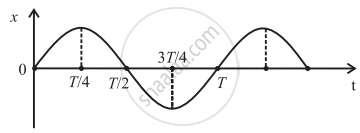
The graph shows variation of displacement of a particle performing S.H.M. with time t. Which of the following statements is correct from the graph?
Using the differential equation of linear S.H.M., obtain an expression for acceleration, velocity, and displacement of simple harmonic motion.
The light of wavelength '`lambda`'. incident on the surface of metal having work function `phi` emits the electrons. The maximum velocity of electrons emitted is ______.
[c = velocity of light, h = Planck's constant, m = mass of electron]
For a particle performing SHM when displacement is x, the potential energy and restoring force acting on it is denoted by E and F, respectively. The relation between x, E and F is ____________.
Two identical wires of substances 'P' and 'Q ' are subjected to equal stretching force along the length. If the elongation of 'Q' is more than that of 'P', then ______.
In U.C.M., when time interval δt → 0, the angle between change in velocity (δv) and linear velocity (v) will be ______.
A wheel of M.I. 50 kg m2 starts rotating on applying a constant torque of 200 Nm. Its angular velocity after 2.5 second from the start is ______.
A particle is moving along a circular path of radius 6 m with a uniform speed of 8 m/s. The average acceleration when the particle completes one-half of the revolution is ______.
A body performing a simple harmonic motion has potential energy 'P1' at displacement 'x1' Its potential energy is 'P2' at displacement 'x2'. The potential energy 'P' at displacement (x1 + x2) is ________.
The phase difference between the instantaneous velocity and acceleration of a particle executing S.H.M is ____________.
If 'α' and 'β' are the maximum velocity and maximum acceleration respectively, of a particle performing linear simple harmonic motion, then the path length of the particle is _______.
The distance covered by a particle undergoing SHM in one time period is (amplitude = A) ____________.
Which of the following represents the acceleration versus displacement graph of SHM?
The displacement of a particle is 'y' = 2 sin `[(pit)/2 + phi]`, where 'y' is cm and 't' in second. What is the maximum acceleration of the particle executing simple harmonic motion?
(Φ = phase difference)
The length of the second's pendulum is decreased by 0.3 cm when it is shifted from place A to place B. If the acceleration due to gravity at place A is 981 cm/s2, the acceleration due to gravity at place B is ______ (Take π2 = 10)
A body is executing S.H.M. Its potential energy is E1 and E2 at displacements x and y respectively. The potential energy at displacement (x + y) is ______.
A body perform linear simple harmonic motion of amplitude 'A'. At what displacement from the mean position, the potential energy of the body is one fourth of its total energy?
The displacement of a particle is represented by the equation `y = 3 cos (pi/4 - 2ωt)`. The motion of the particle is ______.
A particle is performing SHM starting extreme position, graphical representation shows that between displacement and acceleration there is a phase difference of ______.
A particle performs linear SHM at a particular instant, velocity of the particle is 'u' and acceleration is a while at another instant velocity is 'v' and acceleration is 'β (0 < α < β). The distance between the two position is ______.
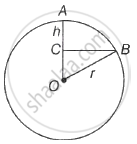
In figure, a particle is placed at the highest point A of a smooth sphere of radius r. It is given slight push and it leaves the sphere at B, at a depth h vertically below A, such that h is equal to ______.
The displacement of a particle of mass 3 g executing simple harmonic motion is given by Y = 3 sin (0.2 t) in SI units. The kinetic energy of the particle at a point which is at a distance equal to `1/3` of its amplitude from its mean position is ______.
A body of mass 0.5 kg travels in a straight line with velocity v = ax3/2 where a = 5 m–1/2s–1. The change in kinetic energy during its displacement from x = 0 to x = 2 m is ______.
State the expressions for the displacement, velocity and acceleration draw performing linear SHM, starting from the positive extreme position. Hence, their graphs with respect to time.
State the expression for the total energy of SHM in terms of acceleration.
A particle executing SHM has velocities v1 and v2 when it is at distance x1 and x2 from the centre of the path. Show that the time period is given by `T=2pisqrt((x_2^2-x_1^2)/(v_1^2-v_2^2))`
