Advertisements
Advertisements
Question
A particle is performing simple harmonic motion with amplitude A and angular velocity ω. The ratio of maximum velocity to maximum acceleration is ______.
Options
ω
1/ω
ω2
A/ω
Advertisements
Solution
A particle is performing simple harmonic motion with amplitude A and angular velocity ω. The ratio of maximum velocity to maximum acceleration is 1/ω.
APPEARS IN
RELATED QUESTIONS
Choose the correct option:
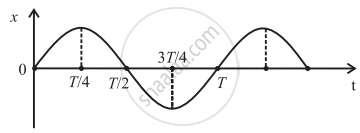
The graph shows variation of displacement of a particle performing S.H.M. with time t. Which of the following statements is correct from the graph?
Find the change in length of a second’s pendulum, if the acceleration due to gravity at the place changes from 9.75 m/s2 to 9.8 m/s2.
The light of wavelength '`lambda`'. incident on the surface of metal having work function `phi` emits the electrons. The maximum velocity of electrons emitted is ______.
[c = velocity of light, h = Planck's constant, m = mass of electron]
For a particle performing SHM when displacement is x, the potential energy and restoring force acting on it is denoted by E and F, respectively. The relation between x, E and F is ____________.
Two identical wires of substances 'P' and 'Q ' are subjected to equal stretching force along the length. If the elongation of 'Q' is more than that of 'P', then ______.
In U.C.M., when time interval δt → 0, the angle between change in velocity (δv) and linear velocity (v) will be ______.
A wheel of M.I. 50 kg m2 starts rotating on applying a constant torque of 200 Nm. Its angular velocity after 2.5 second from the start is ______.
The relation between time and displacement for two particles is given by Y1 = 0.06 sin 27`pi` (0.04t + `phi_1`), y2 = 0.03sin 27`pi`(0.04t + `phi_2`). The ratio of the intensity of the waves produced by the vibrations of the two particles will be ______.
The phase difference between the instantaneous velocity and acceleration of a particle executing S.H.M is ____________.
If 'α' and 'β' are the maximum velocity and maximum acceleration respectively, of a particle performing linear simple harmonic motion, then the path length of the particle is _______.
The distance covered by a particle undergoing SHM in one time period is (amplitude = A) ____________.
A body of mass 5 g is in S.H.M. about a point with amplitude 10 cm. Its maximum velocity is 100 cm/s. Its velocity will be 50 cm/s at a distance of, ____________.
The length of the second's pendulum is decreased by 0.3 cm when it is shifted from place A to place B. If the acceleration due to gravity at place A is 981 cm/s2, the acceleration due to gravity at place B is ______ (Take π2 = 10)
A body is executing S.H.M. Its potential energy is E1 and E2 at displacements x and y respectively. The potential energy at displacement (x + y) is ______.
A simple pendulum of length 'L' is suspended from a roof of a trolley. A trolley moves in horizontal direction with an acceleration 'a'. What would be the period of oscillation of a simple pendulum?
(g is acceleration due to gravity)
The bob of a simple pendulum is released at time t = 0 from a position of small angular displacement. Its linear displacement is ______.
(l = length of simple pendulum and g = acceleration due to gravity, A = amplitude of S.H.M.)
A block of mass 16 kg moving with velocity 4 m/s on a frictionless surface compresses an ideal spring and comes to rest. If force constant of the spring is 100 N/m then how much will be the spring compressed?
The displacement of the particle performing S.H.M. is given by x = 4 sin πt, where x is in cm and t is in second. The time taken by the particle in second to move from the equilibrium position to the position of half the maximum displacement, is ______.
`[sin30^circ=cos60^circ=0.5, cos30^circ=sin60^circ=sqrt3/2]`
The displacement of a particle is represented by the equation `y = 3 cos (pi/4 - 2ωt)`. The motion of the particle is ______.
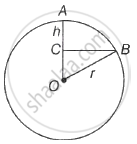
In figure, a particle is placed at the highest point A of a smooth sphere of radius r. It is given slight push and it leaves the sphere at B, at a depth h vertically below A, such that h is equal to ______.
A spring of force constant of 400 N/m is loaded with a mass of 0.25 kg. The amplitude of oscillations is 4 cm. When mass comes to the equilibrium position. Its velocity is ______.
Calculate the velocity of a particle performing S.H.M. after 1 second, if its displacement is given by x = `5sin((pit)/3)`m.
For a particle performing circular motion, when is its angular acceleration directed opposite to its angular velocity?
State the expression for the total energy of SHM in terms of acceleration.
A body is suspended from the two light springs separately, the periods of vertical oscillations are \[T_1\] and \[T_2\]. The same body is suspended from two springs connected in series first and then in parallel. The periods of oscillations in both cases respectively are ______.
A particle performs simple harmonic motion with amplitude A. Its speed is tripled at the instant that it is at a distance `(2 A)/3` from equilibrium position. The new amplitude of the motion is ______.
