Advertisements
Advertisements
प्रश्न
A particle is performing simple harmonic motion with amplitude A and angular velocity ω. The ratio of maximum velocity to maximum acceleration is ______.
विकल्प
ω
1/ω
ω2
A/ω
Advertisements
उत्तर
A particle is performing simple harmonic motion with amplitude A and angular velocity ω. The ratio of maximum velocity to maximum acceleration is 1/ω.
APPEARS IN
संबंधित प्रश्न
Acceleration of a particle executing S.H.M. at its mean position.
A particle is performing S.H.M. of amplitude 5 cm and period of 2s. Find the speed of the particle at a point where its acceleration is half of its maximum value.
The light of wavelength '`lambda`'. incident on the surface of metal having work function `phi` emits the electrons. The maximum velocity of electrons emitted is ______.
[c = velocity of light, h = Planck's constant, m = mass of electron]
Two identical wires of substances 'P' and 'Q ' are subjected to equal stretching force along the length. If the elongation of 'Q' is more than that of 'P', then ______.
The displacement of a particle from its mean position (in metre) is given by, y = 0.2 sin(10 πt + 1.5π) cos(10 πt + 1.5π).
The motion of particle is ____________.
In U.C.M., when time interval δt → 0, the angle between change in velocity (δv) and linear velocity (v) will be ______.
A wheel of M.I. 50 kg m2 starts rotating on applying a constant torque of 200 Nm. Its angular velocity after 2.5 second from the start is ______.
A particle is moving along a circular path of radius 6 m with a uniform speed of 8 m/s. The average acceleration when the particle completes one-half of the revolution is ______.
A body performing a simple harmonic motion has potential energy 'P1' at displacement 'x1' Its potential energy is 'P2' at displacement 'x2'. The potential energy 'P' at displacement (x1 + x2) is ________.
The relation between time and displacement for two particles is given by Y1 = 0.06 sin 27`pi` (0.04t + `phi_1`), y2 = 0.03sin 27`pi`(0.04t + `phi_2`). The ratio of the intensity of the waves produced by the vibrations of the two particles will be ______.
A body of mass 5 g is in S.H.M. about a point with amplitude 10 cm. Its maximum velocity is 100 cm/s. Its velocity will be 50 cm/s at a distance of, ____________.
The displacement of a particle is 'y' = 2 sin `[(pit)/2 + phi]`, where 'y' is cm and 't' in second. What is the maximum acceleration of the particle executing simple harmonic motion?
(Φ = phase difference)
The maximum speed of a particle in S.H.M. is 'V'. The average speed is ______
A body is executing S.H.M. Its potential energy is E1 and E2 at displacements x and y respectively. The potential energy at displacement (x + y) is ______.
A simple pendulum of length 'L' is suspended from a roof of a trolley. A trolley moves in horizontal direction with an acceleration 'a'. What would be the period of oscillation of a simple pendulum?
(g is acceleration due to gravity)
The bob of a simple pendulum is released at time t = 0 from a position of small angular displacement. Its linear displacement is ______.
(l = length of simple pendulum and g = acceleration due to gravity, A = amplitude of S.H.M.)
The displacements of two particles executing simple harmonic motion are represented as y1 = 2 sin (10t + θ) and y2 = 3 cos 10t. The phase difference between the velocities of these waves is ______.
A body perform linear simple harmonic motion of amplitude 'A'. At what displacement from the mean position, the potential energy of the body is one fourth of its total energy?
A particle of mass 5 kg moves in a circle of radius 20 cm. Its linear speed at a time t is given by v = 4t, t is in the second and v is in ms-1. Find the net force acting on the particle at t = 0.5 s.
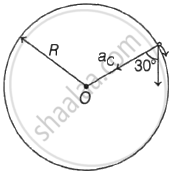
In the given figure, a = 15 m/s2 represents the total acceleration of a particle moving in the clockwise direction on a circle of radius R = 2.5 m at a given instant of time. The speed of the particle is ______.
Calculate the velocity of a particle performing S.H.M. after 1 second, if its displacement is given by x = `5sin((pit)/3)`m.
State the expressions for the displacement, velocity and acceleration draw performing linear SHM, starting from the positive extreme position. Hence, their graphs with respect to time.
A particle executing SHM has velocities v1 and v2 when it is at distance x1 and x2 from the centre of the path. Show that the time period is given by `T=2pisqrt((x_2^2-x_1^2)/(v_1^2-v_2^2))`
