Advertisements
Advertisements
Question
An orchid plant is growing on the branch of a mango tree. How do you describe this interaction between the orchid and the mango tree?
Advertisements
Solution
Orchids are epiphytes that inhabit mangos. In this example of commensalism, the mango tree is virtually neither aided nor injured, while the orchid obtains support and access to light and air. In addition to using specialised aerial roots called velamen to absorb moisture from the atmosphere, epiphytic orchids produce their own sustenance through photosynthesis.
RELATED QUESTIONS
Describe the mutual relationship between fig tree and wasp and comment on the phenomenon that operates in their relationship.
How is mutualism different from commensalism?
Name the two intermediate hosts which the human liver fluke depends on to complete its life cycle so as to facilitate parasitization of its primary host.
Competition and Mutualism.
Name the type of association: Crow feeding the hatchling of Koel
What is ESS?
Explain any three important characteristics of population.
Explain different population interactions with examples.
What is commensalism? Explain it with a suitable example.
Define population growth. Explain different types of age pyramids.
Match the following and choose the correct combination from the options given below.
| Column I | Column II |
| Mutualism | Lion and deer |
| Commensalism | Round worm and man |
| Parasitism | Birds compete with squirrels for nuts |
| Competition | Sea anemone on hermit crab |
| Predation | Barnacles attached to Whales |
Differentiate between predator and prey.
Identify the interspecific interaction in which species A is harmed and species B is unaffected.
Mutualism can be represented as the interaction between ____________.
The interspecific interaction between Cuckoo and Crow is ______
Which population interaction can be represented by'+''-'?
Lichens showing relationship between alga and fungus is an example of ____________ type of interaction.
Which one of the following is one of the characteristics of a biological community?
The presence or interference of one species leads to reduction in feeding efficiency of other species is termed as
What is mycorrhiza?
What are the organisms that feed on plant sap and other plant parts called?
What is brood parasitism? Explain with the help of an example.
In a pond, we see plants which are free-floating; rooted–submerged; rooted emergent; rooted with floating leaves; Write the type of plant against the following examples.
| Plant Name | Type | |
| a. | Hydrilla | ______ |
| b. | Typha | ______ |
| c. | Nymphaea | ______ |
| d. | Lemna | ______ |
| e. | Vallisneria | ______ |
Give one example for the following type.
Camouflaged animal
Give one example for the following type.
Biological control agent
Observe the set of 4 figures A, B, C and D and, answer the following questions
- Which one of the figures shows mutualism?
- What kind of association is shown in D?
- Name the organisms and the association in C.
- What role is the insect performing in B?
 Fig. (A) |
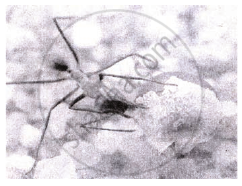 Fig. (B) |
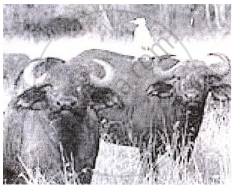 Fig. (C) |
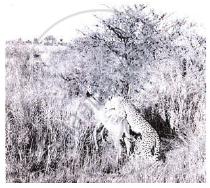 Fig. (D) |
Give one example for the following:
A parasitic angiosperm
The interaction between cattle egret and the buffalo is ______.
The value of 'Z' (regression coefficient) lies in the range of ______ regardless of the taxonomic group or the region.
Between which among the following, the relationship is not an example of
?
Interaction between clown fish living among the stinging tentacles of sea anemone is an example of ______.
"Some species of insects and frogs have evolved with various specific features that help them from being detected."
- Justify the statement giving reasons.
- Mention any two such features.
The diagram given below shows the life cycle of a malarial parasite. Study it carefully and answer the questions that follows:

- Name the hosts in which the asexual phase and sexual phase of the life cycle takes place.
- Identify the infective stage labelled ‘D’.
- Name the structure labelled ‘A’ and ‘E’.
- Give any one symptom of malaria.
Give one example of commensalism.
Explain one type of mutualism.
Statement I: Gause’s competitive exclusion principle states that two closely related species competing for different resources cannot exist indefinitely.
Statement II: According to Gause’s principle, during competition, the inferior will be eliminated. This may be true if resources are limiting.
In the light of the above statements, choose the correct answer from the options given below:
In the sign convention for population interactions, what does the symbol '+' represent?
Which interaction type is characterized by both species being benefited?
What is the sign convention for commensalism?
In neutralism, what is the relationship between the two species?
