Advertisements
Advertisements
Question
An image formed by a lens is erect. Such an image could be formed by a
Options
convex lens provided the image is smaller than object.
concave lens provided the image is smaller than object.
concave lens provided the image is larger than object.
concave lens provided the image is of the same size.
Advertisements
Solution
concave lens provided the image is smaller than object.
Explanation:
A concave lens provided the image is smaller than an object. The image of an object created by a concave lens is erect, virtual and diminished.
APPEARS IN
RELATED QUESTIONS
It is desired to obtain an erect image of an object, using concave mirror of focal length of 12 cm.
What should be the range of distance of an object placed in front of the mirror?
A spherical mirror produces an image of magnification −1 on a screen placed at a distance of 40 cm from the mirror:
(i) Write the type of mirror.
(ii) What is the nature of the image formed?
(iii) How far is the object located from the mirror?
(iv) Draw the ray diagram to show the image formation in this case.
Fill in the following blank with suitable word:
The focal length of a concave mirror is the distance from the ......... to the mirror.
For a convex mirror, parallel rays of light appear to diverge from a point called the ______.
Draw the following diagram in your answer book and show the formation of image of the object AB with the help of suitable rays:
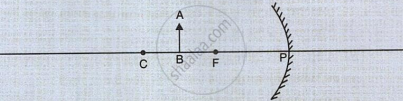
between its pole and focus
Describe the nature, size and position of the image formed in each case.
State one use of concave mirror bases on the formation of image as in case (i) above.
If the object is moved further away from the mirror, what changes are there in the position and size of the image?
State two uses of a concave mirror.
Pick out the concave and convex mirrors from the following and tabulate them.
Rear-view mirror, Dentist’s mirror, Torchlight mirror, Mirrors in shopping malls, Make-up mirror.
______ mirrors make things look larger when objects are placed close to them.
