Advertisements
Advertisements
प्रश्न
An image formed by a lens is erect. Such an image could be formed by a
विकल्प
convex lens provided the image is smaller than object.
concave lens provided the image is smaller than object.
concave lens provided the image is larger than object.
concave lens provided the image is of the same size.
Advertisements
उत्तर
concave lens provided the image is smaller than object.
Explanation:
A concave lens provided the image is smaller than an object. The image of an object created by a concave lens is erect, virtual and diminished.
APPEARS IN
संबंधित प्रश्न
If the image formed by a mirror for all positions of the object placed in front of it is always erect and diminished, what type of mirror is it? Draw a ray diagram to justify your answer. Where and why do we generally use this type of mirror?
A communications satellite in orbit sends a parallel beam of signals down to earth. If these signals obey the same laws of reflection as light and are to be focussed onto a small receiving aerial, what should be the best shape of the metal 'dish' used to collect them?
According to New Cartesian Sign Convention:
(a) focal length of concave mirror is positive and that of convex mirror is negative
(b) focal length of both concave and convex mirrors is positive
(c) focal length of both concave and convex mirrors is negative
(d) focal length of concave mirror is negative and that of convex mirror is positive
How far should an object be placed from the pole of a converging mirror of focal length 20cm to form a real image of the size exactly `1/4`th the size of the object?
What type of image/images are formed by:
a convex mirror?
Draw and complete the following diagrams to show what happens to the beams of light as they enter the glass block and then leave it:
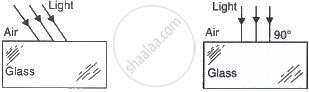
Suppose you have three concave mirrors A, B and C of focal lengths 10 cm, 15 cm and 20 cm. For each concave mirror you perform the experiment of image formation for three values of object distance of 10 cm, 20 cm and 30 cm. Giving reason answer the following:
(a) For the three object distances, identify the mirror/mirrors which will form an image of magnification – 1.
(b) Out of the three mirrors identify the mirror which would be preferred to be used for shaving purposes/makeup.
(c) For the mirror B draw ray diagram for image formation for object distances 10 cm and 20 cm.
Rays from Sun converge at a point 15 cm in front of a concave mirror. Where should an object be placed so that size of its image is equal to the size of the object?
Under which of the following conditions a concave mirror can form an image larger than the actual object?
Between which two points of a concave mirror should an object be placed to obtain a magnification of -2?
