Advertisements
Advertisements
Question
A small piece of wood is floating on the surface of a 2.5 m deep lake. Where does the shadow form on the bottom when the sum is just setting? Refractive index of water = 4/3.
Advertisements
Solution
Given,
Depth of the lake = 2.5 m
Refractive index (μ) of water = \[\frac{4}{3}\]
When the sun is just setting, θ is approximately = 90˚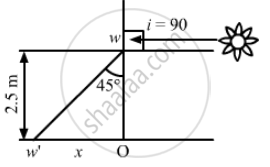
Therefore, incidence angle is 90˚
Using Snell's law:
\[\therefore \frac{\sin i}{\sin r} = \frac{\mu_2}{\mu_1}\]
⇒ `1/ sin r = ( 4/3 )/1`
⇒ `r = 49^circ `
From the figure, W'O = x is the distance of the shadow
Thus, `(x/2.5) = tan r = 1.15`
⇒ x=2.5×1.15=2.8 m
APPEARS IN
RELATED QUESTIONS
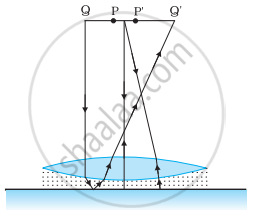
Figure shows an equiconvex lens (of refractive index 1.50) in contact with a liquid layer on top of a plane mirror. A small needle with its tip on the principal axis is moved along the axis until its inverted image is found at the position of the needle. The distance of the needle from the lens is measured to be 45.0 cm. The liquid is removed and the experiment is repeated. The new distance is measured to be 30.0 cm. What is the refractive index of the liquid?
A double convex lens of + 5 D is made of glass of refractive index 1.55 with both faces of equal radii of curvature. Find the value of its radius of curvature.
Two converging lenses of unequal focal lengths can be used to reduce the aperture of a parallel beam of light without loosing the energy of the light. This increase the intensity. Describe how the converging lenses should be placed to do this.
In many experimental set-ups the source and screen are fixed at a distance say D and the lens is movable. Show that there are two positions for the lens for which an image is formed on the screen. Find the distance between these points and the ratio of the image sizes for these two points.
Show that the least possible distance between an object and its real image in a convex lens is 4f, where f is the focal length of the lens.
A transparent refracting medium bounded by two surfaces, of which at least one is spherical, is called a:
The point near the centre of a thin lens through which a ray of light passes without appreciable deviation is called the:
The point on the principal axis where rays parallel to the principal axis actually meet after refraction, or appear to diverge after refraction, is called the:
The distance between the optical centre and the principal focus is called the:
The ratio of the height of the image to the height of the object is called:
For a thin lens, the magnification \[m\] in terms of image distance \[v\] and object distance \[u\] is given by:
According to the new Cartesian sign convention for lenses, the focal length of a concave lens is:
According to the new Cartesian sign convention used for lenses, distances measured opposite to the direction of incident light are taken as:
According to the new Cartesian sign convention, all distances in lens problems are measured from:
A ray of light passing through the optical centre of a thin lens:
A ray parallel to the principal axis, after refraction through a concave lens, appears to diverge from:
A concave lens is used in spectacles for myopia because it:
