Advertisements
Advertisements
प्रश्न
A small piece of wood is floating on the surface of a 2.5 m deep lake. Where does the shadow form on the bottom when the sum is just setting? Refractive index of water = 4/3.
Advertisements
उत्तर
Given,
Depth of the lake = 2.5 m
Refractive index (μ) of water = \[\frac{4}{3}\]
When the sun is just setting, θ is approximately = 90˚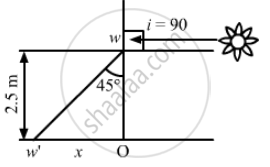
Therefore, incidence angle is 90˚
Using Snell's law:
\[\therefore \frac{\sin i}{\sin r} = \frac{\mu_2}{\mu_1}\]
⇒ `1/ sin r = ( 4/3 )/1`
⇒ `r = 49^circ `
From the figure, W'O = x is the distance of the shadow
Thus, `(x/2.5) = tan r = 1.15`
⇒ x=2.5×1.15=2.8 m
APPEARS IN
संबंधित प्रश्न
A beam of light converges at a point P. Now a lens is placed in the path of the convergent beam 12 cm from P. At what point does the beam converge if the lens is
- a convex lens of focal length 20 cm, and
- a concave lens of focal length 16 cm?
An object of size 3.0 cm is placed 14 cm in front of a concave lens of focal length 21 cm. Describe the image produced by the lens. What happens if the object is moved further away from the lens?
A screen is placed 90 cm from an object. The image of the object on the screen is formed by a convex lens at two different locations separated by 20 cm. Determine the focal length of the lens.
An object 1.5 cm in size is placed on the side of the convex lens in the arrangement (a) above. The distance between the object and the convex lens is 40 cm. Determine the magnification produced by the two-lens system, and the size of the image
An equiconvex lens of focal length 'f' is cut into two identical plane convex lenses. How will the power of each part be related to the focal length of the original lens ?
A pin of length 2.0 cm lies along the principal axis of a converging lens, the centre being at a distance of 11 cm from the lens. The focal length of the lens is 6 cm. Find the size of the image.
An unsymmetrical double convex thin lens forms the image of a point object on its axis. Will the position of the image change if the lens is reversed?
The distance between the optical centre and the principal focus is called the:
According to the new Cartesian sign convention used for lenses, distances measured opposite to the direction of incident light are taken as:
According to the new Cartesian sign convention, all distances in lens problems are measured from:
A ray of light passing through the optical centre of a thin lens:
A ray passing through the principal focus of a convex lens, after refraction, emerges:
A ray directed towards the principal focus of a concave lens, after refraction, emerges:
A lens with an infinite focal length behaves like:
Magnification produced by a lens is positive when the image is:
A concave lens is used in spectacles for myopia because it:
