Advertisements
Advertisements
प्रश्न
An unsymmetrical double convex thin lens forms the image of a point object on its axis. Will the position of the image change if the lens is reversed?
Advertisements
उत्तर
Thin lens formula: `1/v - 1/u = 1/f`
For a given object position if focal length of the lens does not change, the image position remains unchanged.
By lens maker's formula,
`1/f = (mu - 1) (1/R_1 - 1/R_2)`
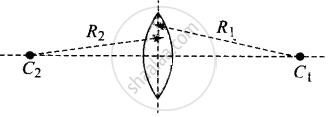
For this position R1 is positive
And R2 is negative. Hence focal length at this position
`1/f_1 = (mu - 1) (1/((+ R_1)) - 1/((-R_2))) = (mu - 1)(1/R_1 + 1/R_2)`
Now the lens is reversed,
At this position R2 is positive and R1 is negative. Hence focal length at this position is
`1/f_2 = (mu - 1) (1/((+ R_2)) - 1/((-R_1))) = (mu - 1)(1/R_1 + 1/R_2)`
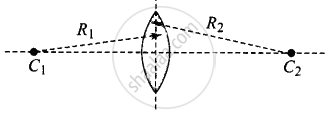
We can observe the focal length of the lens does not change in both positions, hence the image position remains unchanged.
APPEARS IN
संबंधित प्रश्न
You have learnt that plane and convex mirrors produce virtual images of objects. Can they produce real images under some circumstances? Explain.
- Determine the ‘effective focal length’ of the combination of the two lenses, if they are placed 8.0 cm apart with their principal axes coincident. Does the answer depend on which side of the combination a beam of parallel light is incident? Is the notion of the effective focal length of this system useful at all?
- An object 1.5 cm in size is placed on the side of the convex lens in the arrangement (a) above. The distance between the object and the convex lens is 40 cm. Determine the magnification produced by the two-lens system and the size of the image.
A man with normal near point (25 cm) reads a book with small print using a magnifying glass: a thin convex lens of focal length 5 cm.
(a) What is the closest and the farthest distance at which he should keep the lens from the page so that he can read the book when viewing through the magnifying glass?
(b) What is the maximum and the minimum angular magnification (magnifying power) possible using the above simple microscope?
A card sheet divided into squares each of size 1 mm2 is being viewed at a distance of 9 cm through a magnifying glass (a converging lens of focal length 9 cm) held close to the eye.
- What is the magnification produced by the lens? How much is the area of each square in the virtual image?
- What is the angular magnification (magnifying power) of the lens?
- Is the magnification in (a) equal to the magnifying power in (b)? Explain.
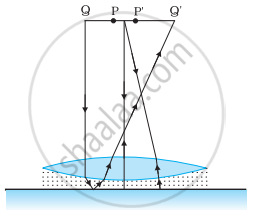
Figure shows an equiconvex lens (of refractive index 1.50) in contact with a liquid layer on top of a plane mirror. A small needle with its tip on the principal axis is moved along the axis until its inverted image is found at the position of the needle. The distance of the needle from the lens is measured to be 45.0 cm. The liquid is removed and the experiment is repeated. The new distance is measured to be 30.0 cm. What is the refractive index of the liquid?
An equiconvex lens of focal length 'f' is cut into two identical plane convex lenses. How will the power of each part be related to the focal length of the original lens ?
Two converging lenses of unequal focal lengths can be used to reduce the aperture of a parallel beam of light without loosing the energy of the light. This increase the intensity. Describe how the converging lenses should be placed to do this.
A convex lens forms a real image of a point object placed on its principals axis. If the upper half of the lens is painted black,
(a) the image will be shifted downward
(b) the image will be shifted upward
(c) the image will not be shifted
(d) the intensity of the image will decrease.
An object approaches a convergent lens from the left of the lens with a uniform speed 5 m/s and stops at the focus. The image ______.
A plano convex lens has diameter of 10 cm and its thickness at the centre is 0.5 cm. Speed of light in the lens is 2 × 10⁸ ms-1. What is the focal length of the lens?

In the Lens Maker's Formula, the symbols \[R_1\] and \[R_2\] denote:
A ray of light passing through the optical centre of a thin lens:
A ray parallel to the principal axis, after refraction through a convex lens, passes through:
A ray parallel to the principal axis, after refraction through a concave lens, appears to diverge from:
A ray passing through the principal focus of a convex lens, after refraction, emerges:
If the refractive index of a liquid equals that of a glass lens (\[n_1 = n_2\]), the lens maker relation gives \[\frac{1}{f} = 0\]. This means the focal length of the lens becomes:
A lens with an infinite focal length behaves like:
Magnification produced by a lens is positive when the image is:
