Advertisements
Advertisements
प्रश्न
Three immiscible liquids of densities d1 > d2 > d3 and refractive indices µ1 > µ2 > µ3 are put in a beaker. The height of each liquid column is `h/3`. A dot is made at the bottom of the beaker. For near normal vision, find the apparent depth of the dot.
Advertisements
उत्तर
Coordinate convention: At the first surface (+ upward and – ve downward)
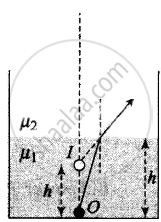
`mu_2/h^' - mu_1/(-h) = (mu_2 - mu_1)/(oo)` (infinity because the surface is plane),
or `h^' = mu_2/mu_1 h`.
The negative sign shows that it is on the side of the object
`h^'` is the apparent depth of O after refraction from the interface.
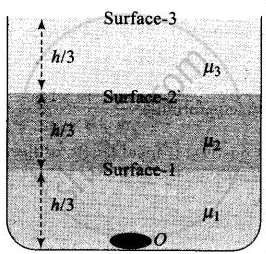
The position of image of O after refraction from surface-1. If seen from `mu_2`, the apparent depth is `h_1`
`h_1 = mu_2/mu_1 h/3`
The negative sign shows that it is on the side of the object.
Since the image formed by surface-1 will act as an object for surface-3. If seen from `mu_3`, the apparent depth is `h_2`.
Similarly, the image formed by Medium 2, O2 acts as an object for MEdium 3.
`h_2 = mu_3/mu_2 (mu_2/mu_1 h/3 + h/3) = - h/3(mu_3/mu_2 + mu_2/mu_1)`
Finally, the image formed by surface-2 will act as an object for surface-2. If seen from the outside, the apparent depth is `h_3`.
`h_3 = - 1/mu_3 [h/3 + h/3(mu_3/mu_2 + mu_3/mu_1)] = - h/3 (1/mu_1 + 1/mu_2 + 1/mu_3)`
Hence apparent depth of dot is `h/3(1/mu_1 + 1/mu_2 + 1/mu_3)`
Xa is apparent depth.
