Advertisements
Advertisements
Question
An unsymmetrical double convex thin lens forms the image of a point object on its axis. Will the position of the image change if the lens is reversed?
Advertisements
Solution
Thin lens formula: `1/v - 1/u = 1/f`
For a given object position if focal length of the lens does not change, the image position remains unchanged.
By lens maker's formula,
`1/f = (mu - 1) (1/R_1 - 1/R_2)`
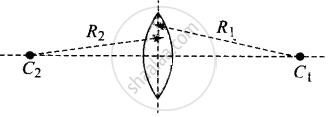
For this position R1 is positive
And R2 is negative. Hence focal length at this position
`1/f_1 = (mu - 1) (1/((+ R_1)) - 1/((-R_2))) = (mu - 1)(1/R_1 + 1/R_2)`
Now the lens is reversed,
At this position R2 is positive and R1 is negative. Hence focal length at this position is
`1/f_2 = (mu - 1) (1/((+ R_2)) - 1/((-R_1))) = (mu - 1)(1/R_1 + 1/R_2)`
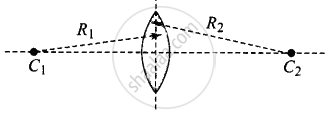
We can observe the focal length of the lens does not change in both positions, hence the image position remains unchanged.
APPEARS IN
RELATED QUESTIONS
A beam of light converges at a point P. Now a lens is placed in the path of the convergent beam 12 cm from P. At what point does the beam converge if the lens is
- a convex lens of focal length 20 cm, and
- a concave lens of focal length 16 cm?
The image of a small electric bulb fixed on the wall of a room is to be obtained on the opposite wall 3 m away by means of a large convex lens. What is the maximum possible focal length of the lens required for the purpose?
Two concave lenses L1 and L2 are kept in contact with each other. If the space between the two lenses is filled with a material of smaller refractive index, the magnitude of the focal length of the combination
Two converging lenses of unequal focal lengths can be used to reduce the aperture of a parallel beam of light without loosing the energy of the light. This increase the intensity. Describe how the converging lenses should be placed to do this.
A pin of length 2.0 cm lies along the principal axis of a converging lens, the centre being at a distance of 11 cm from the lens. The focal length of the lens is 6 cm. Find the size of the image.
Answer the following question.
An optical instrument uses a lens of 100 D for the objective lens and 50 D for its eyepiece. When the tube length is kept at 20 cm, the final image is formed at infinity.
(a) Identify the optical instrument.
(b) Calculate the magnification produced by the instrument.
Will the focal length of a lens for red light be more, same or less than that for blue light?
In many experimental set-ups the source and screen are fixed at a distance say D and the lens is movable. Show that there are two positions for the lens for which an image is formed on the screen. Find the distance between these points and the ratio of the image sizes for these two points.
A transparent refracting medium bounded by two surfaces, of which at least one is spherical, is called a:
The point near the centre of a thin lens through which a ray of light passes without appreciable deviation is called the:
For a thin lens, the magnification \[m\] in terms of image distance \[v\] and object distance \[u\] is given by:
A ray parallel to the principal axis, after refraction through a convex lens, passes through:
If the refractive index of a liquid equals that of a glass lens (\[n_1 = n_2\]), the lens maker relation gives \[\frac{1}{f} = 0\]. This means the focal length of the lens becomes:
A lens with an infinite focal length behaves like:
Magnification produced by a lens is positive when the image is:
