Advertisements
Advertisements
प्रश्न
Two converging lenses of unequal focal lengths can be used to reduce the aperture of a parallel beam of light without loosing the energy of the light. This increase the intensity. Describe how the converging lenses should be placed to do this.
Advertisements
उत्तर
Let the two converging lenses be L1 and L2, with focal lengths f1 and f2 respectively.
To reduce the aperture of a parallel beam of light without losing the energy of the light and also increase the intensity, we have to place the lens L2 within the focal range of L1.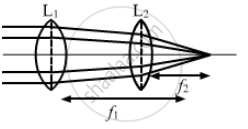
APPEARS IN
संबंधित प्रश्न
An object 1.5 cm in size is placed on the side of the convex lens in the arrangement (a) above. The distance between the object and the convex lens is 40 cm. Determine the magnification produced by the two-lens system, and the size of the image
A double convex lens of + 5 D is made of glass of refractive index 1.55 with both faces of equal radii of curvature. Find the value of its radius of curvature.
Two concave lenses L1 and L2 are kept in contact with each other. If the space between the two lenses is filled with a material of smaller refractive index, the magnitude of the focal length of the combination
A pin of length 2.0 cm lies along the principal axis of a converging lens, the centre being at a distance of 11 cm from the lens. The focal length of the lens is 6 cm. Find the size of the image.
Will the focal length of a lens for red light be more, same or less than that for blue light?
A plano convex lens has diameter of 10 cm and its thickness at the centre is 0.5 cm. Speed of light in the lens is 2 × 10⁸ ms-1. What is the focal length of the lens?

In the given figure the radius of curvature of the curved face in the planoconvex and the planoconcave lens is 15 cm each. The refractive index of the material of the lenses is 1.5. Find the final position of the image formed.

The straight line passing through the optical centre and the centres of curvature of the lens surfaces is called the:
The point near the centre of a thin lens through which a ray of light passes without appreciable deviation is called the:
The ratio of the height of the image to the height of the object is called:
According to the new Cartesian sign convention for lenses, the focal length of a concave lens is:
According to the new Cartesian sign convention used for lenses, distances measured opposite to the direction of incident light are taken as:
According to the new Cartesian sign convention for lenses, heights measured below the principal axis are taken as:
A ray of light passing through the optical centre of a thin lens:
A ray parallel to the principal axis, after refraction through a concave lens, appears to diverge from:
Using the sign convention with \[OB = -u\] and \[DI = +v\] in the combined refraction equation for a thin lens gives:
A lens with an infinite focal length behaves like:
Magnification produced by a lens is positive when the image is:
