Advertisements
Advertisements
प्रश्न
Will the focal length of a lens for red light be more, same or less than that for blue light?
Advertisements
उत्तर
The refractive index depends on colour of light or wavelength of light.
Cauchy's equation: `mu = A+ B/lambda^2 + C/lambda^4 + ...`
As λred > λblue hence μred < μblue
Hence parallel beams of light incident on alens will be bent more towards the axis for blue light compared to red.
By lens maker's formula,
`1/f = (mu - 1)(1/R_1 - 1/R_2)`
The refractive index for red light is less than that for blue light μred < μblue
Hence `1/f_("red") < 1/f_("blue") ⇒ f_("red") > f_("blue")`
Thus, the focal length for red light will be greater than that for blue light.
APPEARS IN
संबंधित प्रश्न
You have learnt that plane and convex mirrors produce virtual images of objects. Can they produce real images under some circumstances? Explain.
The image of a small electric bulb fixed on the wall of a room is to be obtained on the opposite wall 3 m away by means of a large convex lens. What is the maximum possible focal length of the lens required for the purpose?
- Determine the ‘effective focal length’ of the combination of the two lenses, if they are placed 8.0 cm apart with their principal axes coincident. Does the answer depend on which side of the combination a beam of parallel light is incident? Is the notion of the effective focal length of this system useful at all?
- An object 1.5 cm in size is placed on the side of the convex lens in the arrangement (a) above. The distance between the object and the convex lens is 40 cm. Determine the magnification produced by the two-lens system and the size of the image.
A man with normal near point (25 cm) reads a book with small print using a magnifying glass: a thin convex lens of focal length 5 cm.
(a) What is the closest and the farthest distance at which he should keep the lens from the page so that he can read the book when viewing through the magnifying glass?
(b) What is the maximum and the minimum angular magnification (magnifying power) possible using the above simple microscope?
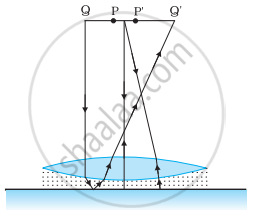
Figure shows an equiconvex lens (of refractive index 1.50) in contact with a liquid layer on top of a plane mirror. A small needle with its tip on the principal axis is moved along the axis until its inverted image is found at the position of the needle. The distance of the needle from the lens is measured to be 45.0 cm. The liquid is removed and the experiment is repeated. The new distance is measured to be 30.0 cm. What is the refractive index of the liquid?
Two concave lenses L1 and L2 are kept in contact with each other. If the space between the two lenses is filled with a material of smaller refractive index, the magnitude of the focal length of the combination
A small piece of wood is floating on the surface of a 2.5 m deep lake. Where does the shadow form on the bottom when the sum is just setting? Refractive index of water = 4/3.
Answer the following question.
An optical instrument uses a lens of 100 D for the objective lens and 50 D for its eyepiece. When the tube length is kept at 20 cm, the final image is formed at infinity.
(a) Identify the optical instrument.
(b) Calculate the magnification produced by the instrument.
An unsymmetrical double convex thin lens forms the image of a point object on its axis. Will the position of the image change if the lens is reversed?
In many experimental set-ups the source and screen are fixed at a distance say D and the lens is movable. Show that there are two positions for the lens for which an image is formed on the screen. Find the distance between these points and the ratio of the image sizes for these two points.
Show that the least possible distance between an object and its real image in a convex lens is 4f, where f is the focal length of the lens.
The point on the principal axis where rays parallel to the principal axis actually meet after refraction, or appear to diverge after refraction, is called the:
The distance between the optical centre and the principal focus is called the:
The ratio of the height of the image to the height of the object is called:
Which of the following correctly represents the Lens Maker's Formula?
According to the new Cartesian sign convention, all distances in lens problems are measured from:
A ray passing through the principal focus of a convex lens, after refraction, emerges:
Using the sign convention with \[OB = -u\] and \[DI = +v\] in the combined refraction equation for a thin lens gives:
A concave lens is used in spectacles for myopia because it:
