Advertisements
Advertisements
प्रश्न
A screen is placed 90 cm from an object. The image of the object on the screen is formed by a convex lens at two different locations separated by 20 cm. Determine the focal length of the lens.
Advertisements
उत्तर
Distance between the image (screen) and the object, D = 90 cm
Distance between two locations of the convex lens, d = 20 cm
Focal length of the lens = f
Focal length is related to d and D as:
`"f" = ("D"^2 - "d"^2)/4"D"`
= `((90)^2 - (20)^2)/(4 xx 90)`
= `770/36`
= 21.39 cm
Therefore, the focal length of the convex lens is 21.39 cm.
संबंधित प्रश्न
You have learnt that plane and convex mirrors produce virtual images of objects. Can they produce real images under some circumstances? Explain.
The image of a small electric bulb fixed on the wall of a room is to be obtained on the opposite wall 3 m away by means of a large convex lens. What is the maximum possible focal length of the lens required for the purpose?
A man with normal near point (25 cm) reads a book with small print using a magnifying glass: a thin convex lens of focal length 5 cm.
(a) What is the closest and the farthest distance at which he should keep the lens from the page so that he can read the book when viewing through the magnifying glass?
(b) What is the maximum and the minimum angular magnification (magnifying power) possible using the above simple microscope?
A card sheet divided into squares each of size 1 mm2 is being viewed at a distance of 9 cm through a magnifying glass (a converging lens of focal length 9 cm) held close to the eye.
- What is the magnification produced by the lens? How much is the area of each square in the virtual image?
- What is the angular magnification (magnifying power) of the lens?
- Is the magnification in (a) equal to the magnifying power in (b)? Explain.
Figure shows an equiconvex lens (of refractive index 1.50) in contact with a liquid layer on top of a plane mirror. A small needle with its tip on the principal axis is moved along the axis until its inverted image is found at the position of the needle. The distance of the needle from the lens is measured to be 45.0 cm. The liquid is removed and the experiment is repeated. The new distance is measured to be 30.0 cm. What is the refractive index of the liquid?
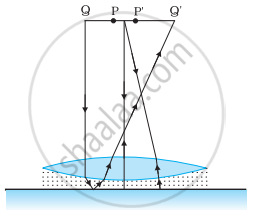
A double convex lens of + 5 D is made of glass of refractive index 1.55 with both faces of equal radii of curvature. Find the value of its radius of curvature.
Two concave lenses L1 and L2 are kept in contact with each other. If the space between the two lenses is filled with a material of smaller refractive index, the magnitude of the focal length of the combination
A convex lens forms a real image of a point object placed on its principals axis. If the upper half of the lens is painted black,
(a) the image will be shifted downward
(b) the image will be shifted upward
(c) the image will not be shifted
(d) the intensity of the image will decrease.
Answer the following question.
An optical instrument uses a lens of 100 D for the objective lens and 50 D for its eyepiece. When the tube length is kept at 20 cm, the final image is formed at infinity.
(a) Identify the optical instrument.
(b) Calculate the magnification produced by the instrument.
An unsymmetrical double convex thin lens forms the image of a point object on its axis. Will the position of the image change if the lens is reversed?
The point near the centre of a thin lens through which a ray of light passes without appreciable deviation is called the:
The ratio of the height of the image to the height of the object is called:
In the Lens Maker's Formula, the symbols \[R_1\] and \[R_2\] denote:
For a thin lens, the magnification \[m\] in terms of image distance \[v\] and object distance \[u\] is given by:
According to the new Cartesian sign convention for lenses, heights measured below the principal axis are taken as:
A ray parallel to the principal axis, after refraction through a concave lens, appears to diverge from:
A ray directed towards the principal focus of a concave lens, after refraction, emerges:
If the refractive index of a liquid equals that of a glass lens (\[n_1 = n_2\]), the lens maker relation gives \[\frac{1}{f} = 0\]. This means the focal length of the lens becomes:
A lens with an infinite focal length behaves like:
