Advertisements
Advertisements
प्रश्न
A small piece of wood is floating on the surface of a 2.5 m deep lake. Where does the shadow form on the bottom when the sum is just setting? Refractive index of water = 4/3.
Advertisements
उत्तर
Given,
Depth of the lake = 2.5 m
Refractive index (μ) of water = \[\frac{4}{3}\]
When the sun is just setting, θ is approximately = 90˚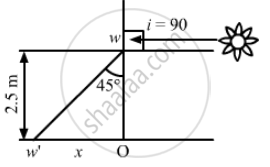
Therefore, incidence angle is 90˚
Using Snell's law:
\[\therefore \frac{\sin i}{\sin r} = \frac{\mu_2}{\mu_1}\]
⇒ `1/ sin r = ( 4/3 )/1`
⇒ `r = 49^circ `
From the figure, W'O = x is the distance of the shadow
Thus, `(x/2.5) = tan r = 1.15`
⇒ x=2.5×1.15=2.8 m
APPEARS IN
संबंधित प्रश्न
A beam of light converges at a point P. Now a lens is placed in the path of the convergent beam 12 cm from P. At what point does the beam converge if the lens is
- a convex lens of focal length 20 cm, and
- a concave lens of focal length 16 cm?
You have learnt that plane and convex mirrors produce virtual images of objects. Can they produce real images under some circumstances? Explain.
An object 1.5 cm in size is placed on the side of the convex lens in the arrangement (a) above. The distance between the object and the convex lens is 40 cm. Determine the magnification produced by the two-lens system, and the size of the image
A double convex lens of + 5 D is made of glass of refractive index 1.55 with both faces of equal radii of curvature. Find the value of its radius of curvature.
Two converging lenses of unequal focal lengths can be used to reduce the aperture of a parallel beam of light without loosing the energy of the light. This increase the intensity. Describe how the converging lenses should be placed to do this.
A convex lens forms a real image of a point object placed on its principals axis. If the upper half of the lens is painted black,
(a) the image will be shifted downward
(b) the image will be shifted upward
(c) the image will not be shifted
(d) the intensity of the image will decrease.
A pin of length 2.0 cm lies along the principal axis of a converging lens, the centre being at a distance of 11 cm from the lens. The focal length of the lens is 6 cm. Find the size of the image.
An object approaches a convergent lens from the left of the lens with a uniform speed 5 m/s and stops at the focus. The image ______.
Will the focal length of a lens for red light be more, same or less than that for blue light?
A plano convex lens has diameter of 10 cm and its thickness at the centre is 0.5 cm. Speed of light in the lens is 2 × 10⁸ ms-1. What is the focal length of the lens?

The point near the centre of a thin lens through which a ray of light passes without appreciable deviation is called the:
According to the new Cartesian sign convention for lenses, the focal length of a concave lens is:
According to the new Cartesian sign convention for lenses, heights measured below the principal axis are taken as:
A ray of light passing through the optical centre of a thin lens:
If the refractive index of a liquid equals that of a glass lens (\[n_1 = n_2\]), the lens maker relation gives \[\frac{1}{f} = 0\]. This means the focal length of the lens becomes:
A concave lens is used in spectacles for myopia because it:
