Advertisements
Advertisements
Question
A six sided die is marked ‘1’ on one face, ‘3’ on two of its faces, and ‘5’ on remaining three faces. The die is thrown twice. If X denotes the total score in two throws, find the cumulative distribution function
Advertisements
Solution
Let X be the random variable denotes the total score in two thrown of a die.
Sample space S
| I\II | 1 | 3 | 3 | 5 | 5 | 5 |
| 1 | 2 | 4 | 4 | 6 | 6 | 6 |
| 3 | 4 | 6 | 6 | 8 | 8 | 8 |
| 3 | 4 | 6 | 6 | 8 | 8 | 8 |
| 5 | 6 | 8 | 8 | 10 | 10 | 10 |
| 5 | 6 | 8 | 8 | 10 | 10 | 10 |
| 5 | 6 | 8 | 8 | 10 | 10 | 10 |
n(S) = 36
X = {2, 4, 6, 8, 10}
| Values of the random variable | 2 | 4 | 6 | 8 | 10 | Total |
| Number of elements in inverse image | 1 | 4 | 10 | 12 | 9 | 36 |
Cumulative distribution function
F(x) = P(X ≤ x)
= `sum_(x_"i" ≤ x) "P"("X" = x_"i")`
F(2) = P(X < 2)
= P(X < 2) + P(X = 2)
= `0 + 1/36`
= `1/36`
F(4) = `"P"("X" ≤ 4)`
= P(X <2) + P(X = 2) + P(X = 4)
= `0+ 1/36 + 4/36`
= `5/36`
F(6) = `"P"("X" ≤ 6)`
= P(X < 2) + P(X = 2) + P(X = 4) + P(X = 6)
= `0 + 11/36+ 4/36 + 10/36`
= `15/36`
F(8) = P(X ≤ 8)
= P(X < 2) + P(X = 2) + P(X = 4) + P(X = 6) + P(X = 8)
= `0 + 1/6 + 4/36 + 10/36 + 12/36`
= `27/36`
F(10) = P(X ≤ 10)
= P(X < 2) + P(X = 2) + P(x = 8) + P(X = 10)
= `0 + 1/36 + 4/36 + 10/36 + 12/36 + 9/36`
= `36/36`
= 1
F(x) = `{{:(0",", "For" - oo < x < 2),(1/36",", "For" 2 ≤ x ≤ 4),(5/36",", "For" 4 ≤ x < 6),(15/36",", "For" 6 ≤ x < 8),(27/36",", "For" 8 ≤ x < 10),(1",", "For" 10 ≤ x < oo):}`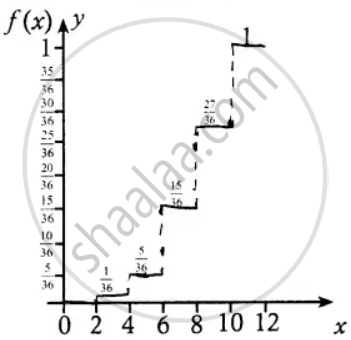
APPEARS IN
RELATED QUESTIONS
Suppose error involved in making a certain measurement is continuous r.v. X with p.d.f.
f (x) = k `(4 – x^2 )`, for –2 ≤ x ≤ 2 and = 0 otherwise.
P(x > 0)
Given the p.d.f. of a continuous r.v. X , f (x) = `x^2/3` ,for –1 < x < 2 and = 0 otherwise
Determine c.d.f. of X hence find
P( x < 1)
Given the p.d.f. of a continuous r.v. X ,
f (x) = `x^2/ 3` , for –1 < x < 2 and = 0 otherwise
Determine c.d.f. of X hence find P( X > 0)
Choose the correct option from the given alternative:
If the a d.r.v. X has the following probability distribution:
| X | 1 | 2 | 3 | 4 | 5 | 6 | 7 |
| P(X=x) | k | 2k | 2k | 3k | k2 | 2k2 | 7k2+k |
k =
The p.m.f. of a r.v. X is given by P (X = x) =`("" ^5 C_x ) /2^5` , for x = 0, 1, 2, 3, 4, 5 and = 0, otherwise.
Then show that P (X ≤ 2) = P (X ≥ 3).
It is felt that error in measurement of reaction temperature (in celsius) in an experiment is a continuous r.v. with p.d.f.
f(x) = `{(x^3/(64), "for" 0 ≤ x ≤ 4),(0, "otherwise."):}`
Find P(0 < X ≤ 1).
Solve the following problem :
Identify the random variable as discrete or continuous in each of the following. Identify its range if it is discrete.
An economist is interested in knowing the number of unemployed graduates in the town with a population of 1 lakh.
Solve the following problem :
Identify the random variable as discrete or continuous in each of the following. Identify its range if it is discrete.
Amount of syrup prescribed by a physician.
Solve the following problem :
Identify the random variable as discrete or continuous in each of the following. Identify its range if it is discrete.
A person on high protein diet is interested in the weight gained in a week.
Solve the following problem :
Identify the random variable as discrete or continuous in each of the following. Identify its range if it is discrete.
A highway safety group is interested in the speed (km/hrs) of a car at a check point.
The probability distribution of a r.v. X is
| X = x | -3 | -2 | -1 | 0 | 1 |
| P(X = x) | 0.3 | 0.2 | 0.25 | 0.1 | 0.15 |
Then F (-1) = ?
Find the probability mass function and cumulative distribution function of a number of girl children in families with 4 children, assuming equal probabilities for boys and girls
Suppose a discrete random variable can only take the values 0, 1, and 2. The probability mass function is defined by
`f(x) = {{:((x^2 + 1)/k"," "for" x = 0"," 1"," 2),(0"," "otherwise"):}`
Find the value of k
Suppose a discrete random variable can only take the values 0, 1, and 2. The probability mass function is defined by
`f(x) = {{:((x^2 + 1)/k"," "for" x = 0"," 1"," 2),(0"," "otherwise"):}`
Find P(X ≥ 1)
The cumulative distribution function of a discrete random variable is given by
F(x) = `{{:(0, - oo < x < - 1),(0.15, - 1 ≤ x < 0),(0.35, 0 ≤ x < 1),(0.60, 1 ≤ x < 2),(0.85, 2 ≤ x < 3),(1, 3 ≤ x < oo):}`
Find the probability mass function
The cumulative distribution function of a discrete random variable is given by
F(x) = `{{:(0, - oo < x < - 1),(0.15, - 1 ≤ x < 0),(0.35, 0 ≤ x < 1),(0.60, 1 ≤ x < 2),(0.85, 2 ≤ x < 3),(1, 3 ≤ x < oo):}`
Find P(X ≥ 2)
A random variable X has the following probability mass function.
| x | 1 | 2 | 3 | 4 | 5 |
| F(x) | k2 | 2k2 | 3k2 | 2k | 3k |
Find the value of k
A random variable X has the following probability mass function.
| x | 1 | 2 | 3 | 4 | 5 |
| F(x) | k2 | 2k2 | 3k2 | 2k | 3k |
Find P(2 ≤ X < 5)
The cumulative distribution function of a discrete random variable is given by
F(x) = `{{:(0, "for" - oo < x < 0),(1/2, "for" 0 ≤ x < 1),(3/5, "for" 1 ≤ x < 2),(4/5, "for" 2 ≤ x < 4),(9/5, "for" 3 ≤ x < 4),(1, "for" ≤ x < oo):}`
Find the probability mass function
The cumulative distribution function of a discrete random variable is given by
F(x) = `{{:(0, "for" - oo < x < 0),(1/2, "for" 0 ≤ x < 1),(3/5, "for" 1 ≤ x < 2),(4/5, "for" 2 ≤ x < 4),(9/5, "for" 3 ≤ x < 4),(1, "for" ≤ x < oo):}`
Find P(X < 3)
The cumulative distribution function of a discrete random variable is given by
F(x) = `{{:(0, "for" - oo < x < 0),(1/2, "for" 0 ≤ x < 1),(3/5, "for" 1 ≤ x < 2),(4/5, "for" 2 ≤ x < 4),(9/5, "for" 3 ≤ x < 4),(1, "for" ≤ x < oo):}`
Find P(X ≥ 2)
Choose the correct alternative:
Two coins are to be flipped. The first coin will land on heads with probability 0.6, the second with Probability 0.5. Assume that the results of the flips are independent and let X equal the total number of heads that result. The value of E[X] is
If the c.d.f (cumulative distribution function) is given by F(x) = `(x - 25)/10`, then P(27 ≤ x ≤ 33) = ______.
If A = {x ∈ R : x2 - 5 |x| + 6 = 0}, then n(A) = _____.
For a random variable X, if Var (X) = 5 and E (X2) = 21, the value of E (X) is ______
A random variable X has the following probability distribution:
| X | 1 | 2 | 3 | 4 |
| P(X) | `1/3` | `2/9` | `1/3` | `1/9` |
1hen, the mean of this distribution is ______
The probability distribution of a random variable X is given below. If its mean is 4.2, then the values of a and bar respectively
| X = x | 1 | 2 | 3 | 4 | 5 | 6 |
| P(X = x) | a | a | a | b | b | 0.3 |
A card is chosen from a well-shuffled pack of cards. The probability of getting an ace of spade or a jack of diamond is ______.
Two coins are tossed. Then the probability distribution of number of tails is.
The c.d.f. of a discrete r.v. x is
| x | 0 | 1 | 2 | 3 | 4 | 5 |
| F(x) | 0.16 | 0.41 | 0.56 | 0.70 | 0.91 | 1.00 |
Then P(1 < x ≤ 4) = ______
The p.d.f. of a continuous random variable X is
f(x) = 0.1 x, 0 < x < 5
= 0, otherwise
Then the value of P(X > 3) is ______
A random variable X has the following probability distribution:
| X = xi | 1 | 2 | 3 | 4 |
| P(X = xi) | 0.2 | 0.15 | 0.3 | 0.35 |
The mean and the variance are respectively ______.
Two cards are randomly drawn, with replacement. from a well shuffled deck of 52 playing cards. Find the probability distribution of the number of aces drawn.
A coin is tossed three times. If X denotes the absolute difference between the number of heads and the number of tails then P(X = 1) = ______.
