Advertisements
Advertisements
प्रश्न
A six sided die is marked ‘1’ on one face, ‘3’ on two of its faces, and ‘5’ on remaining three faces. The die is thrown twice. If X denotes the total score in two throws, find the cumulative distribution function
Advertisements
उत्तर
Let X be the random variable denotes the total score in two thrown of a die.
Sample space S
| I\II | 1 | 3 | 3 | 5 | 5 | 5 |
| 1 | 2 | 4 | 4 | 6 | 6 | 6 |
| 3 | 4 | 6 | 6 | 8 | 8 | 8 |
| 3 | 4 | 6 | 6 | 8 | 8 | 8 |
| 5 | 6 | 8 | 8 | 10 | 10 | 10 |
| 5 | 6 | 8 | 8 | 10 | 10 | 10 |
| 5 | 6 | 8 | 8 | 10 | 10 | 10 |
n(S) = 36
X = {2, 4, 6, 8, 10}
| Values of the random variable | 2 | 4 | 6 | 8 | 10 | Total |
| Number of elements in inverse image | 1 | 4 | 10 | 12 | 9 | 36 |
Cumulative distribution function
F(x) = P(X ≤ x)
= `sum_(x_"i" ≤ x) "P"("X" = x_"i")`
F(2) = P(X < 2)
= P(X < 2) + P(X = 2)
= `0 + 1/36`
= `1/36`
F(4) = `"P"("X" ≤ 4)`
= P(X <2) + P(X = 2) + P(X = 4)
= `0+ 1/36 + 4/36`
= `5/36`
F(6) = `"P"("X" ≤ 6)`
= P(X < 2) + P(X = 2) + P(X = 4) + P(X = 6)
= `0 + 11/36+ 4/36 + 10/36`
= `15/36`
F(8) = P(X ≤ 8)
= P(X < 2) + P(X = 2) + P(X = 4) + P(X = 6) + P(X = 8)
= `0 + 1/6 + 4/36 + 10/36 + 12/36`
= `27/36`
F(10) = P(X ≤ 10)
= P(X < 2) + P(X = 2) + P(x = 8) + P(X = 10)
= `0 + 1/36 + 4/36 + 10/36 + 12/36 + 9/36`
= `36/36`
= 1
F(x) = `{{:(0",", "For" - oo < x < 2),(1/36",", "For" 2 ≤ x ≤ 4),(5/36",", "For" 4 ≤ x < 6),(15/36",", "For" 6 ≤ x < 8),(27/36",", "For" 8 ≤ x < 10),(1",", "For" 10 ≤ x < oo):}`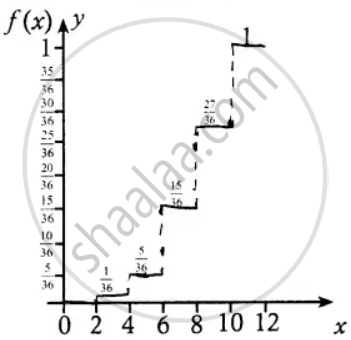
APPEARS IN
संबंधित प्रश्न
The following is the p.d.f. of continuous r.v.
f (x) = `x/8`, for 0 < x < 4 and = 0 otherwise.
Find expression for c.d.f. of X
Given the p.d.f. of a continuous r.v. X , f (x) = `x^2/3` ,for –1 < x < 2 and = 0 otherwise
Determine c.d.f. of X hence find
P( x < 1)
Given the p.d.f. of a continuous r.v. X ,
f (x) = `x^2/ 3` , for –1 < x < 2 and = 0 otherwise
Determine c.d.f. of X hence find P( X > 0)
Choose the correct option from the given alternative:
If the a d.r.v. X has the following probability distribution:
| X | 1 | 2 | 3 | 4 | 5 | 6 | 7 |
| P(X=x) | k | 2k | 2k | 3k | k2 | 2k2 | 7k2+k |
k =
In the p.m.f. of r.v. X
| X | 1 | 2 | 3 | 4 | 5 |
| P (X) | `1/20` | `3/20` | a | 2a | `1/20` |
Find a and obtain c.d.f. of X.
Solve the following problem :
A player tosses two coins. He wins ₹ 10 if 2 heads appear, ₹ 5 if 1 head appears, and ₹ 2 if no head appears. Find the expected value and variance of winning amount.
It is felt that error in measurement of reaction temperature (in celsius) in an experiment is a continuous r.v. with p.d.f.
f(x) = `{(x^3/(64), "for" 0 ≤ x ≤ 4),(0, "otherwise."):}`
Verify whether f(x) is a p.d.f.
It is felt that error in measurement of reaction temperature (in celsius) in an experiment is a continuous r.v. with p.d.f.
f(x) = `{(x^3/(64), "for" 0 ≤ x ≤ 4),(0, "otherwise."):}`
Find P(0 < X ≤ 1).
It is felt that error in measurement of reaction temperature (in celsius) in an experiment is a continuous r.v. with p.d.f.
f(x) = `{(x^3/(64), "for" 0 ≤ x ≤ 4),(0, "otherwise."):}`
Find probability that X is between 1 and 3..
Fill in the blank :
The values of discrete r.v. are generally obtained by _______
Solve the following problem :
Identify the random variable as discrete or continuous in each of the following. Identify its range if it is discrete.
Twelve of 20 white rats available for an experiment are male. A scientist randomly selects 5 rats and counts the number of female rats among them.
Solve the following problem :
Identify the random variable as discrete or continuous in each of the following. Identify its range if it is discrete.
A highway safety group is interested in the speed (km/hrs) of a car at a check point.
A six sided die is marked ‘1’ on one face, ‘3’ on two of its faces, and ‘5’ on remaining three faces. The die is thrown twice. If X denotes the total score in two throws, find P(4 ≤ X < 10)
Find the probability mass function and cumulative distribution function of a number of girl children in families with 4 children, assuming equal probabilities for boys and girls
Suppose a discrete random variable can only take the values 0, 1, and 2. The probability mass function is defined by
`f(x) = {{:((x^2 + 1)/k"," "for" x = 0"," 1"," 2),(0"," "otherwise"):}`
Find the value of k
Suppose a discrete random variable can only take the values 0, 1, and 2. The probability mass function is defined by
`f(x) = {{:((x^2 + 1)/k"," "for" x = 0"," 1"," 2),(0"," "otherwise"):}`
Find cumulative distribution function
The cumulative distribution function of a discrete random variable is given by
F(x) = `{{:(0, - oo < x < - 1),(0.15, - 1 ≤ x < 0),(0.35, 0 ≤ x < 1),(0.60, 1 ≤ x < 2),(0.85, 2 ≤ x < 3),(1, 3 ≤ x < oo):}`
Find P(X < 1)
The cumulative distribution function of a discrete random variable is given by
F(x) = `{{:(0, - oo < x < - 1),(0.15, - 1 ≤ x < 0),(0.35, 0 ≤ x < 1),(0.60, 1 ≤ x < 2),(0.85, 2 ≤ x < 3),(1, 3 ≤ x < oo):}`
Find P(X ≥ 2)
A random variable X has the following probability mass function.
| x | 1 | 2 | 3 | 4 | 5 |
| F(x) | k2 | 2k2 | 3k2 | 2k | 3k |
Find P(2 ≤ X < 5)
The cumulative distribution function of a discrete random variable is given by
F(x) = `{{:(0, "for" - oo < x < 0),(1/2, "for" 0 ≤ x < 1),(3/5, "for" 1 ≤ x < 2),(4/5, "for" 2 ≤ x < 4),(9/5, "for" 3 ≤ x < 4),(1, "for" ≤ x < oo):}`
Find the probability mass function
Choose the correct alternative:
Two coins are to be flipped. The first coin will land on heads with probability 0.6, the second with Probability 0.5. Assume that the results of the flips are independent and let X equal the total number of heads that result. The value of E[X] is
Choose the correct alternative:
Which of the following is a discrete random variable?
I. The number of cars crossing a particular signal in a day.
II. The number of customers in a queue to buy train tickets at a moment.
III. The time taken to complete a telephone call.
Let X = time (in minutes) that lapses between the ringing of the bell at the end of a lecture and the actual time when the professor ends the lecture. Suppose X has p.d.f.
f(x) = `{(kx^2"," 0 ≤ x ≤ 2), (0"," "othenwise"):}`
Then, the probability that the lecture ends within 1 minute of the bell ringing is ______
If the c.d.f (cumulative distribution function) is given by F(x) = `(x - 25)/10`, then P(27 ≤ x ≤ 33) = ______.
If the probability function of a random variable X is defined by P(X = k) = a`((k + 1)/2^k)` for k - 0, 1, 2, 3, 4, 5, then the probability that X takes a prime value is ______
A random variable X has the following probability distribution:
| X | 1 | 2 | 3 | 4 |
| P(X) | `1/3` | `2/9` | `1/3` | `1/9` |
1hen, the mean of this distribution is ______
X is a continuous random variable with a probability density function
f(x) = `{{:(x^2/4 + k; 0 ≤ x ≤ 2),(0; "otherwise"):}`
The value of k is equal to ______
The probability distribution of a random variable X is given below. If its mean is 4.2, then the values of a and bar respectively
| X = x | 1 | 2 | 3 | 4 | 5 | 6 |
| P(X = x) | a | a | a | b | b | 0.3 |
A card is chosen from a well-shuffled pack of cards. The probability of getting an ace of spade or a jack of diamond is ______.
Two coins are tossed. Then the probability distribution of number of tails is.
The c.d.f. of a discrete r.v. x is
| x | 0 | 1 | 2 | 3 | 4 | 5 |
| F(x) | 0.16 | 0.41 | 0.56 | 0.70 | 0.91 | 1.00 |
Then P(1 < x ≤ 4) = ______
The c.d.f. of a discrete r.v. X is
| X = x | -4 | -2 | -1 | 0 | 2 | 4 | 6 | 8 |
| F(x) | 0.2 | 0.4 | 0.55 | 0.6 | 0.75 | 0.80 | 0.95 | 1 |
Then P(X ≤ 4|X > -1) = ?
The p.d.f. of a continuous random variable X is
f(x) = 0.1 x, 0 < x < 5
= 0, otherwise
Then the value of P(X > 3) is ______
A random variable X has the following probability distribution:
| X = xi | 1 | 2 | 3 | 4 |
| P(X = xi) | 0.2 | 0.15 | 0.3 | 0.35 |
The mean and the variance are respectively ______.
Two cards are randomly drawn, with replacement. from a well shuffled deck of 52 playing cards. Find the probability distribution of the number of aces drawn.
For the following distribution function F(x) of a rv.x.
| x | 1 | 2 | 3 | 4 | 5 | 6 |
| F(x) | 0.2 | 0.37 | 0.48 | 0.62 | 0.85 | 1 |
P(3 < x < 5) =
