Advertisements
Advertisements
प्रश्न
A six sided die is marked ‘1’ on one face, ‘3’ on two of its faces, and ‘5’ on remaining three faces. The die is thrown twice. If X denotes the total score in two throws, find the probability mass function
Advertisements
उत्तर
Let X be the random variable denotes the total score in two thrown of a die.
Sample space S
| I\II | 1 | 3 | 3 | 5 | 5 | 5 |
| 1 | 2 | 4 | 4 | 6 | 6 | 6 |
| 3 | 4 | 6 | 6 | 8 | 8 | 8 |
| 3 | 4 | 6 | 6 | 8 | 8 | 8 |
| 5 | 6 | 8 | 8 | 10 | 10 | 10 |
| 5 | 6 | 8 | 8 | 10 | 10 | 10 |
| 5 | 6 | 8 | 8 | 10 | 10 | 10 |
n(S) = 36
X = {2, 4, 6, 8, 10}
| Values of the random variable | 2 | 4 | 6 | 8 | 10 | Total |
| Number of elements in inverse image | 1 | 4 | 10 | 12 | 9 | 36 |
Probability mass function
| x | 2 | 4 | 6 | 8 | 10 |
| f(x) | `1/36` | `4/36` | `10/36` | `12/36` | `9/36` |
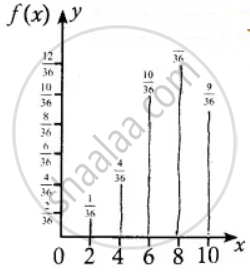
APPEARS IN
संबंधित प्रश्न
Suppose error involved in making a certain measurement is continuous r.v. X with p.d.f.
f (x) = k `(4 – x^2 )`, for –2 ≤ x ≤ 2 and = 0 otherwise.
P(x > 0)
Suppose error involved in making a certain measurement is continuous r.v. X with p.d.f.
f (x) = k `(4 – x^2)`, for –2 ≤ x ≤ 2 and = 0 otherwise.
P (–0·5 < x or x > 0·5)
The following is the p.d.f. of continuous r.v.
f (x) = `x/8` , for 0 < x < 4 and = 0 otherwise.
Find F(x) at x = 0·5 , 1.7 and 5
Given the p.d.f. of a continuous r.v. X ,
f (x) = `x^2/3` , for –1 < x < 2 and = 0 otherwise
Determine c.d.f. of X hence find P(1 < x < 2)
Given the p.d.f. of a continuous r.v. X ,
f (x) = `x^2/ 3` , for –1 < x < 2 and = 0 otherwise
Determine c.d.f. of X hence find P( X > 0)
The p.m.f. of a r.v. X is given by P (X = x) =`("" ^5 C_x ) /2^5` , for x = 0, 1, 2, 3, 4, 5 and = 0, otherwise.
Then show that P (X ≤ 2) = P (X ≥ 3).
Solve the following problem :
A player tosses two coins. He wins ₹ 10 if 2 heads appear, ₹ 5 if 1 head appears, and ₹ 2 if no head appears. Find the expected value and variance of winning amount.
It is felt that error in measurement of reaction temperature (in celsius) in an experiment is a continuous r.v. with p.d.f.
f(x) = `{(x^3/(64), "for" 0 ≤ x ≤ 4),(0, "otherwise."):}`
Find P(0 < X ≤ 1).
It is felt that error in measurement of reaction temperature (in celsius) in an experiment is a continuous r.v. with p.d.f.
f(x) = `{(x^3/(64), "for" 0 ≤ x ≤ 4),(0, "otherwise."):}`
Find probability that X is between 1 and 3..
F(x) is c.d.f. of discrete r.v. X whose p.m.f. is given by P(x) = `"k"^4C_x` , for x = 0, 1, 2, 3, 4 and P(x) = 0 otherwise then F(5) = _______
Fill in the blank :
The value of continuous r.v. are generally obtained by _______
Solve the following problem :
Identify the random variable as discrete or continuous in each of the following. Identify its range if it is discrete.
Amount of syrup prescribed by a physician.
Solve the following problem :
Identify the random variable as discrete or continuous in each of the following. Identify its range if it is discrete.
A person on high protein diet is interested in the weight gained in a week.
Solve the following problem :
Identify the random variable as discrete or continuous in each of the following. Identify its range if it is discrete.
A highway safety group is interested in the speed (km/hrs) of a car at a check point.
c.d.f. of a discrete random variable X is
The probability distribution of a r.v. X is
| X = x | -3 | -2 | -1 | 0 | 1 |
| P(X = x) | 0.3 | 0.2 | 0.25 | 0.1 | 0.15 |
Then F (-1) = ?
A coin is tossed 10 times. The probability of getting exactly six heads is ______.
A six sided die is marked ‘1’ on one face, ‘3’ on two of its faces, and ‘5’ on remaining three faces. The die is thrown twice. If X denotes the total score in two throws, find the cumulative distribution function
A six sided die is marked ‘1’ on one face, ‘3’ on two of its faces, and ‘5’ on remaining three faces. The die is thrown twice. If X denotes the total score in two throws, find P(X ≥ 6)
The cumulative distribution function of a discrete random variable is given by
F(x) = `{{:(0, - oo < x < - 1),(0.15, - 1 ≤ x < 0),(0.35, 0 ≤ x < 1),(0.60, 1 ≤ x < 2),(0.85, 2 ≤ x < 3),(1, 3 ≤ x < oo):}`
Find the probability mass function
The cumulative distribution function of a discrete random variable is given by
F(x) = `{{:(0, - oo < x < - 1),(0.15, - 1 ≤ x < 0),(0.35, 0 ≤ x < 1),(0.60, 1 ≤ x < 2),(0.85, 2 ≤ x < 3),(1, 3 ≤ x < oo):}`
Find P(X ≥ 2)
A random variable X has the following probability mass function.
| x | 1 | 2 | 3 | 4 | 5 |
| F(x) | k2 | 2k2 | 3k2 | 2k | 3k |
Find the value of k
The cumulative distribution function of a discrete random variable is given by
F(x) = `{{:(0, "for" - oo < x < 0),(1/2, "for" 0 ≤ x < 1),(3/5, "for" 1 ≤ x < 2),(4/5, "for" 2 ≤ x < 4),(9/5, "for" 3 ≤ x < 4),(1, "for" ≤ x < oo):}`
Find the probability mass function
Choose the correct alternative:
Suppose that X takes on one of the values 0, 1 and 2. If for some constant k, P(X = i) = kP(X = i – 1) for i = 1, 2 and P(X = 0) = `1/7`. Then the value of k is
The p.m.f. of a random variable X is
P(x) = `(5 - x)/10`, x = 1, 2, 3, 4
= 0, otherwise
The value of E(X) is ______
X is a continuous random variable with a probability density function
f(x) = `{{:(x^2/4 + k; 0 ≤ x ≤ 2),(0; "otherwise"):}`
The value of k is equal to ______
A card is chosen from a well-shuffled pack of cards. The probability of getting an ace of spade or a jack of diamond is ______.
The c.d.f. of a discrete r.v. x is
| x | 0 | 1 | 2 | 3 | 4 | 5 |
| F(x) | 0.16 | 0.41 | 0.56 | 0.70 | 0.91 | 1.00 |
Then P(1 < x ≤ 4) = ______
The c.d.f. of a discrete r.v. X is
| X = x | -4 | -2 | -1 | 0 | 2 | 4 | 6 | 8 |
| F(x) | 0.2 | 0.4 | 0.55 | 0.6 | 0.75 | 0.80 | 0.95 | 1 |
Then P(X ≤ 4|X > -1) = ?
The p.d.f. of a continuous random variable X is
f(x) = 0.1 x, 0 < x < 5
= 0, otherwise
Then the value of P(X > 3) is ______
At random variable X – B(n, p), if values of mean and variance of X are 18 and 12 respectively, then total number of possible values of X are ______.
If f(x) = `k/2^x` is a probability distribution of a random variable X that can take on the values x = 0, 1, 2, 3, 4. Then, k is equal to ______.
