Advertisements
Advertisements
Question
A ray of monochromatic light is incident from the air on a glass slab:
(i) Draw a labelled ray diagram showing the change in the path of the ray till it emerges from the glass slab.
(ii) Name the two rays that are parallel to each other.
(iii) Mark the lateral displacement in your diagram.
Advertisements
Solution
(i) Ray diagram of monochromatic light

(ii) Incident ray and emergent rays are parallel to each other.
(iii) Lateral displacement is marked by d in the diagram.
RELATED QUESTIONS
The speed of light in glass is 2 × 10⁵ km/s. What is the refractive index of glass?
Draw the diagram given below and clearly show the path taken by the emergent ray.
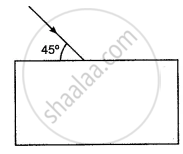
Light passes through a rectangular glass slab and through a triangular glass prism. In what way does the direction of the two emergent beams differ and why?
Why is the ratio of the velocities of light of wavelengths 4000Å and 8000Å in vacuum 1: 1?
How does the angle of deviation produced by a prism change with increase in the angle of incidence. Draw a curve showing the variation in the angle of deviation with the angle of incidence at a prism surface.
Draw a ray diagram showing the lateral displacement of a ray of light when it passes through a parallel sided glass slab.
How does the deviation produced by a prism depend on the wavelength of incident light?
Write a relation between the angle of incidence (i), angle of emergence (e), angle of the prism (A), and angle of deviation (d) for a ray of light passing through an equilateral prism.
Complete the ray diagram showing its emergence into the air after passing through the prism.

A ray of light strikes the surface of a rectangular glass slab such that the angle of incidence in air is
- 0°,
- 45°.
In each case, draw a diagram to show the path taken by the ray as it passes through the glass slab and emerges from it.
