Advertisements
Advertisements
Question
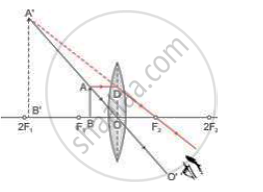
A lens forms an erect, magnified and virtual image of an object.Draw a ray diagram to show the formation of image.
Advertisements
Solution
RELATED QUESTIONS
A lens forms an erect, magnified, and virtual image of an object. Name the device which uses this principle.
The focal length of a convex lens is 25 cm. At what distance from the optical centre of the lens an object be placed to obtain a virtual image of twice the size?
An illuminated object lies at a distance 1.0 m from a screen. A convex lens is used to form the image of the object on a screen placed at a distance of 75 cm from the lens. Find:
- the focal length of the lens, and
- the magnification.
An object is placed at a distance of 20 cm in front of a concave lens of focal length 20 cm. find: the magnification of image.
Define the term magnifying power of a simple microscope. How does it depend on the focal length of the lens used?
Why is the focal length of the lens, used as a magnifying glass, kept short?
What is a simple microscope or a magnifying glass? Draw a ray diagram to show its function.
An erect, magnified, and a virtual image is formed when an object is placed between the optical centre and principal focus of a lens.
(i) Name the lens.
(ii) Draw a ray diagram to show the formation of the image with the above-stated characteristics.
(i) Draw a ray diagram to show how the lens can be used as a ‘magnifying glass’? State the nature of the lens.
(ii) In what respect does the image in (i) above different from the image formed by a concave lens?
State two uses of magnifying glass.
