Advertisements
Advertisements
Question
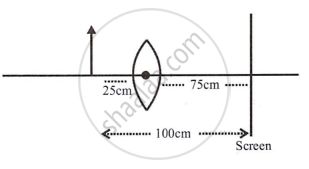
An illuminated object lies at a distance 1.0 m from a screen. A convex lens is used to form the image of the object on a screen placed at a distance of 75 cm from the lens. Find:
- the focal length of the lens, and
- the magnification.
Advertisements
Solution
Distance of object from screen = 1.0 m = 100 cm
v = 75 cm,
u = 100 – 75 = 25 cm = -25 cm
(i) f = ?
`1/"f" = 1/"v" -1/"u"`
= `1/75 - (1/-25)`
= `1/75 + 1/25`
`1/"f" = (1 + 3)/75 = 4/75`
f = `75/4`
f = 18.75
(ii) Magnification (m) = `v/u = 75/-25 = -3`
Magnification (m) = 3
The -ve symbol indicates that the created image is actual and inverted.
APPEARS IN
RELATED QUESTIONS
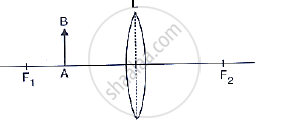
The following diagram shows an object AB and a converging lens L with foci F1 and F2 State three characteristics of the image in relation to the object.
A lens forms an erect, magnified and virtual image of an object. Draw a ray diagram to show the formation of image.
Draw a neat labelled ray diagram to show the formation of an image by a magnifying glass. State three characteristics of the image.
An object is placed at a distance of 20 cm in front of a concave lens of focal length 20 cm. find: the magnification of image.
Name the lens used as a magnifying glass.
Name the lens for which magnification is always less than 1.
A convex lens produces on a screen an image twice the size of the object. If the position of image and object be interchanged, what will be the magnification then?
Show with the help of a ray diagram, the path of the ray when incident normally on the first surface of the glass block, through the block and the liquid.
Draw a neat diagram to explain the action of a convergent (convex) lens as a reading glass (or magnifying glass). State the characteristics of the image formed.
What is a simple microscope or a magnifying glass? Draw a ray diagram to show its function.
